Adaptive learning in five questions
Do you know what adaptive learning is? In this article we tell you about some of this instruction method’s keys which, if well implemented, can take personalised learning to another level.

Do you know what adaptive learning is? In this article we tell you about some of this instruction method’s keys which, if well implemented, can take personalised learning to another level.
Although, of course, its universalization has taken place in recent years due to the great development of artificial intelligence and the popularization of new technologies, adaptive learning has its roots in the 1950s and even earlier. Its precursors and bases can be found in:
As mentioned before, with the evolution of Information and Communication Technologies, and as computers have become smaller more powerful and less expensive, adaptive learning is now applicable to classroom teaching, distance learning and tutoring scenarios. Moreover, we are at a particularly opportune moment, thanks to the convergence of three elements (Lemke, 2014):
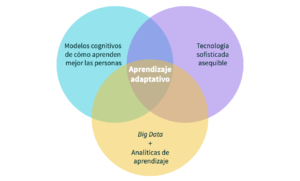 Source: Observatorio de Innovación Educativa del Tecnológico de Monterrey.
What are its main advantages?
The advantages of properly applied adaptive learning, are many. Among the main ones, we can highlight the following (Inspiratics and Observatory of Educational Innovation):
How can we apply it in the classroom?
How to apply adaptive learning in the classroom? The Inspiratics portal offers some tools differentiated by educational level to enjoy the benefits of adaptive learning in the classroom.
Adaptive learning in pre-primary and primary school
At these education levels, where new knowledge is being learned in all subjects, adaptive learning platforms related to reading or mathematical skills are very useful.
Adaptive learning in secondary and baccalaureate education
In these advanced courses, where attention must be paid to other issues such as concentration, memory or study motivation, these platforms help reinforce content by using gamification. or through challenges.
Is it useful in vulnerable environments?
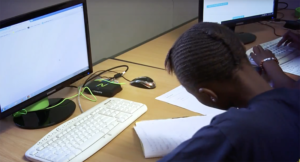
We have already talked about how digital education and new technologies, when properly used, can generate more and better opportunities for vulnerable children and young people. Education supported by new technologies allows for democratization of learning, it provides easy and inexpensive access to educational content and resources in multiple formats which can be used in different places and at different times.
Evidence tells us that EdTech interventions focused on self-directed learning, work best to improve teaching practices or student learning in low- and middle-income contexts (Rodriguez Segura, 2020).
However, for them to work properly, there must be several enabling conditions (Wilichowski and Cobo, 2021):
The proper implementation of these intelligent tutoring systems requires considering two possible “counter-indications”:
Adaptive learning is a great technological tool to improve the quality of learning. Properly implemented, adaptive systems have the potential to improve teachers’ instructing ways, improve student learning and help policy makers better understand what is happening in classrooms.
We have known for some time that “one-size-fits-all” learning does not work in the 21st century. Artificial intelligence and data analytics can mean a quantum leap in personalised learning. Let’s make it happen.
REFERENCES:
Dean Jr, D. and Kuhn, D. (2007). Direct Instructions vs. Discovery. Science Education. Volume 91, Issue 3. P. 384-397.
Inspiratics. Everything you need to know about adaptive learning. Viewed on March 31st, 2022. Retrieved from https://inspiratics.org/es/recursos-educativos/todo-lo-que-debes-saber-sobre-el-aprendizaje-adaptativo/
Lemke, C. 2014. Intelligent Adaptive Learning: An Essential Element of 21st Century Teaching and Learning. In Dreambox Learning. Viewed on March 31st, 2022. Retrieved from https://www.dreambox.com/resources/white-paper/intelligent-adaptive-learning-an-essential-element-of-21st-century-teaching-and-learning
Educational Innovation Observatory. (2014). Adaptive learning and assessment. EduTrends Report. Monterrey Institute of Technology. Available at https://static1.squarespace.com/static/53aadf1de4b0a0a817640cca/t/611289bd7a11e63e81fa831b/1628604863592/02.+Edu+Trends+AE-A.pdf
Rodríguez Segura, D. (2020). Educational Technology in Developing Countries: A Systematic Review. University of Virginia. Working Paper.
Wilichowski, T. and Cobo, C. (January, 2021). Are you considering an adaptive learning system? A roadmap for policy makers. Education for Global Development. World Bank Blogs. Viewed on April 1st, 2022. Available at https://blogs.worldbank.org/es/education/esta-considerando-un-sistema-de-aprendizaje-adaptativo-una-hoja-de-ruta-para-los