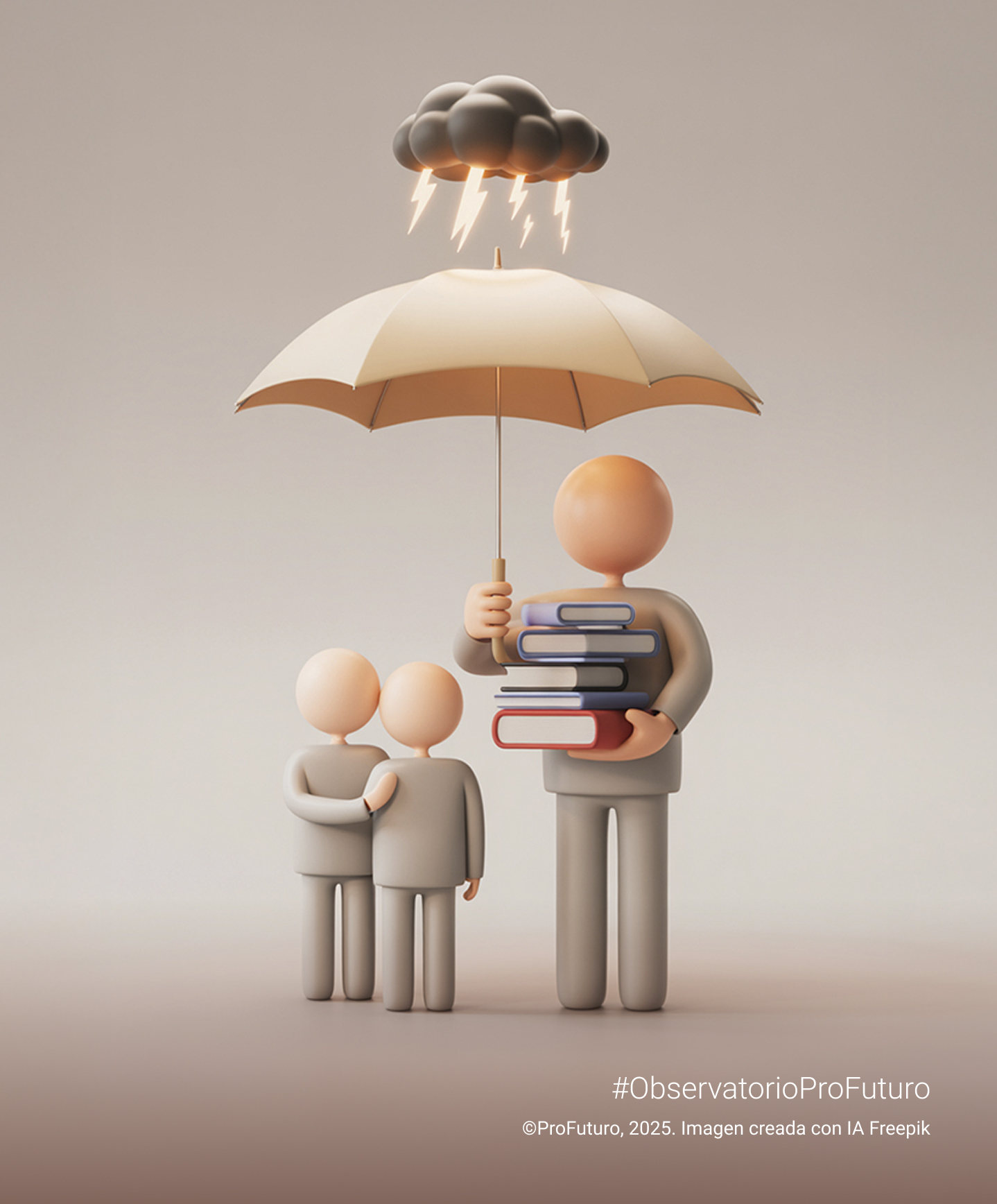
 Education has always shown surprising resilience: one would think that wars, disasters or mass displacement would destroy it like other institutions, but it remains, faltering, yes, but still standing. However, in recent years we have witnessed a perfect storm.
The increasingly frequent combination of armed conflict, forced displacement, extreme weather events and chronic inequalities has destroyed any expectation of normality in millions of schools. UNESCO states this in its report Guidelines on Competencies for Teachers in Emergency and Protracted Crisis Situations (2025): educational emergencies are no longer accidents, but the new structural condition in vast areas of the planet. The figures serve to back up this assertion. Before the pandemic, there were already more than 127 million children and young people out of school in crisis-affected countries; afterwards, the curve only went up. COVID-19 not only closed schools: it exposed the fact that education systems (even formally robust ones) were ill-prepared to ensure continuity in adverse situations.
Education, which should be a buffer, acted more like a barometer marking the drop in pressure.
Moreover, emergencies are not always visible. They can be a prolonged drought that empties classrooms due to hunger or an outbreak of violence that forces entire families to flee overnight. They can be a neighbourhood where the school is the only institution that has not left because it cannot. In all these contexts, the right to education becomes extremely fragile.
And yet it is precisely this right that sustains any possibility of a future.
The centrality of the teaching role
Amidst the usual noise that accompanies any crisis (sirens, official statements, alarmist headlines), there is a figure who does not usually appear on the front pages, but without whom the collapse would be total: the teacher. When everything else fails, they remain. Not out of obligation, but out of a vocation and intuition that tells them that if the school disappears, so does the thread that holds the community together.
The UNESCO report puts it in these terms: teachers are the first line of educational response in an emergency. Not only because they are the ones who open (or improvise) the classroom every morning, but because, in practice, they take on roles that exceed any reasonable professional description. In contexts of violence, displacement or climate chaos, a teacher is not “just” a teacher. They are a mediator, a guide, an emotional support, a figure of security and, sometimes, the only recognisable institution for children who have lost everything else.
In areas where the state arrives late, arrives little or does not arrive at all, teachers act as the human infrastructure of the right to education. It is often they who detect signs of trauma, hunger or risk; who curb the advance of violence in the classroom; who rebuild routines when normality has evaporated. And they do so without manuals, without guarantees, without minimum conditions in most cases. They have the capacity to sustain educational continuity even when the system cannot.
It is a striking contrast: emergencies destroy buildings, roads and services, but there is one thing that always remains: the relationship between a teacher and their students. Without trained teachers, that relationship becomes fragile. With trained teachers, it may be the only thing that keeps a community’s present and future afloat.
Teachers are the first line of educational response in an emergency. Not only because they are the ones who open (or improvise) the classroom every morning, but because, in practice, they take on roles that exceed any reasonable professional description.
The six core competencies
If the last decade (pandemic included) has made one thing clear, it is that teaching in stable contexts is one thing and teaching in the midst of turmoil is quite another. UNESCO has summarised this difference in six competencies, the minimum tools a teacher needs to sustain learning in a scenario that changes from week to week, sometimes hour to hour.
Social-emotional well-being and self-care
There is a paradox in teaching: teachers are expected to be emotional anchors for their students, but they are rarely granted that same right for themselves. UNESCO’s framework reverses that logic: teacher well-being is not a means to an end, it is an end in itself.
In emergencies, this is a matter of professional survival. Teachers deal with prolonged stress, fear, uncertainty and, in too many cases, their own trauma. Teaching under such conditions without emotional support would be like asking an electrical cable to work while it is sparking.
Competence includes self-regulation skills, stress management, recognition of signs of exhaustion, and a repertoire of self-care practices that sound less like self-help and more like preventive maintenance. An emotionally stable teacher can offer what students need most in a crisis: safety, calm, and a sense of continuity.
Training in cultures of peace, human rights and sustainable development
In emergencies, school can be the first line of defence against violence and discrimination. That is why this second competency is not diplomatic rhetoric: it is operational. Teachers must be familiar with concepts such as coexistence, citizenship, diversity, gender equality and peaceful conflict resolution.
Educating in crises, according to UNESCO, requires a worldview that does not reproduce the violence it seeks to stop. In classrooms where migrant children, victims of displacement or students who have seen more than any child should see coexist, teachers must be able to instil a culture of respect that does not crumble at the first provocation.
This skill is, in essence, an antidote: it prevents the school from being contaminated by the logic that destroyed life outside its walls.
Specific pedagogies for crises
If an earthquake destroys a school, no one would be surprised if the building had to be rebuilt differently. However, for years we have insisted that pedagogy could remain the same, even when the context was falling apart.
Emergencies prove otherwise. Teachers need to manage multimodal, accelerated and flexible education, emergency curriculum adaptations, distance learning and methodologies that allow fractured trajectories to be rebuilt.
This does not mean “giving less”, but teaching differently: condensed curricula when time is short, accelerated learning for students with interruptions, digital tools that work with or without connectivity, approaches such as Universal Design for Learning, which allow for heterogeneous levels to be catered for in the same space. It is a pedagogy of contingency, yes, but also a pedagogy of the future.
Training in inclusion
Diversity is not a problem to be solved, but an accurate portrait of contemporary classrooms. But in emergency situations, that diversity multiplies: migrant students, unidentified traumas, invisible disabilities, language barriers, everyday racism, microaggressions that go unnoticed.
Inclusion competence requires teachers to be able to detect, understand and address this variety of needs without falling into the trap of homogenisation. This is where intercultural sensitivity, gender perspective, attention to disability, prevention of bullying and the ability to identify violence that does not leave bruises come in.
It is an exercise in everyday justice: enabling every student to learn, even when their life outside the classroom is a puzzle.
Teacher leadership and decision-making autonomy
In emergencies, teachers don’t just teach: they decide. They decide how to reorganise a class when the school loses power, how to respond when a newly displaced student arrives, how to act if an episode of violence arises. Autonomy is not a privilege, it is a requirement.
Leadership here is not like that described in corporate manuals. It is leadership of proximity: the kind that sustains group morale, encourages exhausted colleagues, coordinates with the community, and calls for support when necessary.
UNESCO points out that this leadership is, in many cases, the factor that makes the difference between an educational centre that collapses and one that reorganises itself.
Peer collaboration networks
An isolated teacher is vulnerable. A network of teachers is an immune system. Communities of practice—whether formal or spontaneous—allow for the sharing of strategies, reduce feelings of professional isolation, find local solutions, and provide emotional support to the team. In emergencies, these networks also function as vectors of innovation and resilience: when a strategy works in one classroom, it is replicated in others.
Recommendations for action
Educational emergencies force the system to reveal its breaking points. And once these are visible, it would be tremendously irresponsible to look the other way. If we truly want education to withstand the next crisis (and it will withstand it, not by miracle but by preparation), it is advisable to transform what we have learned into political decisions.
The first recommendation is so obvious that it is surprising that it is not yet the norm: integrate emergency training into initial teacher training as a structural competence. Teachers should leave their studies knowing how to sustain learning in a classroom that is no longer a classroom, in a school that has closed, or in a neighbourhood where the only predictable thing is instability. Crises are no longer the exception; preparing for them should not be either.
Second recommendation: consolidate multimodal and flexible education as a permanent infrastructure. The pandemic made this clear, but what came after confirmed it: it is not about having a “plan B”, but about having a system with multiple avenues for continuity.
Hybrid materials, condensable curricula, functional platforms without connectivity, preloaded devices… all of which seemed experimental a few years ago is now the difference between continuing to learn or being left behind. Third: weave teaching networks that transcend the logic of the isolated classroom. The problems of emergencies are regional, and so are their solutions, when they appear.
A transnational community of practice can generate more resilience than a battery of ministerial decrees. The fact that what a teacher learns on the southern border of Mexico can be useful to another in Darien is not idealism: it is a strategy.
Fourth: make teacher well-being a public policy with metrics and funding, not institutional voluntarism. No system works if its backbone is broken.
And finally, a recommendation that is too urgent to continue postponing: systematically train teachers in violence prevention and school protection. In many contexts, this is the difference between a school that cares and a school that loses its students forever.
Crises will continue to arise… Are we equipping teachers?
In times of crisis, education is the only thing that prevents the emergency from becoming destiny. Teachers know this better than anyone. They maintain that thread of continuity with a mixture of skill, stubbornness and a vocation that resists even when the context falls apart.
Crises will continue to arise. Climate, violence and inequalities do not wait for the education system to catch up. But there is one thing we can decide: whether we leave teachers on their own or give them the skills, support and professional dignity they need to continue being, as they already are, the backbone of educational resilience in times of crisis.
Because, in the end, the future is also built in the midst of chaos. And it is built through teaching.