

Starting from “zero”
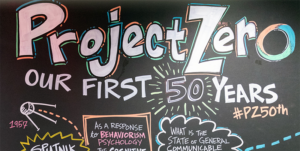 In the late 1950s, philosopher Nelson Goodman, passionate about the arts, began to question the nature of artistic knowledge: how do we think when we interpret, observe, or create? What mental processes are involved in artistic practice? Can these processes be taught?
Convinced that artistic knowledge was as complex and valuable as scientific knowledge, Goodman launched an interdisciplinary project in 1967 whose name, “Zero,” reflected his premise: knowledge about arts education was practically nonexistent.
That small team began exploring seemingly simple questions, such as which visual cues allow us to perceive a cubic shape or how artistic sensitivity develops in early childhood. They also worked with artists from various disciplines to analyze the deep thinking required for quality creative production.
From the arts to human learning
Over time, the project evolved to study broader dimensions of human learning. Thus, what began as a study of artistic knowledge transformed into a laboratory of ideas about intelligence, understanding, thinking, creativity, ethics, and culture.
Figures such as Howard Gardner, who would later develop the theory of multiple intelligences, and David Perkins, a mathematician and expert in artificial intelligence, expanded the scope of the project. Their interest moved toward broader questions. For example: What does it mean to truly understand something? What conditions allow this type of understanding to develop? What makes a person think critically, creatively, or flexibly? Can this kind of thinking be taught?
The answers led to the development of initiatives that are now global references, such as Understanding by Design, Agency by Design, GoodWork Project, and studies on global competencies. But perhaps the most influential contribution, and the most applicable in everyday classrooms, was the development of visible thinking and, within it, thinking routines.
A plot twist: learning is a consequence of thinking
One of the key principles of Project Zero is that deep understanding is not an accumulation of data, but the ability to use, analyze, reinterpret, and transfer it to new situations. In the words of David Perkins: “You can have a lot of information about something and still understand very little.”
This diagnosis is not trivial. It implies that traditional practices centered on memorization are misaligned with real learning. Students may recall a historical date or a scientific definition, but forget its meaning within weeks because they never had to think about it in a meaningful way.
That is why Perkins insists on two essential questions:
- What do we teach?
- How do we teach it?
His thesis is that if we want truly meaningful education, it is not enough to transmit content: we must teach ways of thinking. And for that, we need tools that make visible what is happening in the student’s mind.
Visible thinking
The concept of visible thinking arises from observing a frequent problem: most of the thinking students do is invisible. They reason silently, interpret silently, infer silently. And when the process is invisible, neither the teacher can assess it nor the student can understand it.
Visible thinking proposes a key shift: externalizing thinking so it can be analyzed, discussed, and refined. This can be done through speech, drawing, concept maps, metaphors, guided discussions. But Project Zero found a particularly effective way to achieve this: thinking routines.
What are thinking routines?
Thinking routines are short, structured, and repeatable procedures that help students activate specific mental processes. They are like little “cognitive switches” that force thinking to move in a particular way: observing, interpreting, inferring, connecting, justifying, comparing, synthesizing.
A routine does not seek the correct answer, but the quality of reasoning. What matters is not what the student thinks, but how they think it.
Routines function as daily training for thinking and activate fundamental cognitive processes such as metacognition (they force students to be aware of how they think), deepening (they foster connections between ideas), transfer (they prepare students to use learning in new contexts), multiple perspectives (they teach students to look at a phenomenon from different angles), and evidence-based reasoning: they require justification.
Through repeated practice, students develop stronger intellectual habits: they observe better, ask more questions, justify more effectively, and listen differently.
From Harvard to the classroom: some thinking routines to apply in class
Although Project Zero developed dozens of routines, experience in classrooms has shown that some are especially useful because of their simplicity, versatility, and ability to generate visible thinking in minutes. These are tools any teacher can integrate into daily planning without completely changing their teaching approach.
Below we present a brief overview of the most relevant ones. Project Zero’s website has a Toolbox where any interested teacher can find numerous routines classified by category of thinking and practical tips for using them.
What makes you say that?
Sometimes a student raises their hand, says something confidently, and the rest nod without thinking. But when the teacher asks, “What makes you say that?”, the atmosphere changes. The statement hangs in the air for a few seconds, as if it needed to be uncovered. The student steps back, searches for the evidence they had not made explicit, looks again at the image, the text, or their memory. “I say it because…,” they begin, and what follows is almost always more interesting than the first answer. Sometimes their reasoning is solid; other times it falls apart when examined closely. But that is the point: thinking stops being automatic and becomes deliberate. In that instant, the classroom stops rewarding speed and starts rewarding clarity.
See – Think – Wonder
The class observes a photograph. For a few seconds no one speaks: they just look. First, they describe what they see without interpreting. It is an exercise in cognitive humility: accepting that we know less than we think. Then comes the “think,” that territory where every gesture, shadow, or tiny detail becomes a clue. Finally, the inevitable question appears: “What else do I need to know?” That last part, the question, is what changes learning. Students no longer expect the teacher to have all the answers. They are the ones who open the door to curiosity.
Think – Puzzle – Explore
Sometimes, before starting a topic, students believe they already know what it is about. They think “electricity” means outlets or “the Middle Ages” means castles. When asked to write what they think they know, they discover the limits of that fragmented knowledge. Then come the questions: some naive, others surprisingly sharp. Suddenly, the entire class becomes a map of shared curiosities. Exploring is no longer an imposed task but a path they themselves have drawn. What used to be curriculum is now a journey.
Think – Pair – Share
There are days when a question becomes too big to think about alone. In those moments, students take one minute—just one—to organize their ideas in silence. Then they pair up and compare their reasoning like people comparing maps of the same territory. Sometimes they agree; sometimes they don’t. But when they share with the class, the ideas are no longer individual: they are refined, polished, almost illuminated by contrast. What could have been a timid answer becomes a collective reflection. And the teacher stops being the center of knowledge and becomes a witness to thinking constructed by all.
Circles of viewpoints
A story, a painting, a historical conflict: any of these transforms when students observe it from different perspectives. One day they are peasants in the French Revolution; another day, silent witnesses in a literary scene. Each perspective offers a partial truth, and together they reveal complexity. The most surprising thing is that when students return to their own voice, their view is no longer the same. They have understood that no one sees everything, that the world fractures into multiple versions, and that listening to others is not courtesy but intelligence.
I used to think – Now I think
This routine seems simple, almost innocent. But it is one that provokes the most silence. Students look back and discover that they no longer think the same. “I used to believe that…,” they write, as if confessing an old misunderstanding. “Now I think that…,” they add, and the transformation appears in two lines. It is not always a major change; sometimes it is a small shift only noticeable when someone forces reflection. But this act of examining one’s own thinking is perhaps the deepest learning: realizing that thinking is not a fixed state but a movement.
Bridge 3–2–1
Before starting a project, students write down three ideas, two questions, and one metaphor. At that moment, everything is provisional, sometimes clumsy. Days or weeks pass: they learn, make mistakes, discover, interpret. Then they return to the first paper and build a bridge to a second one: three new ideas, two new questions, one different metaphor. In the comparison between the two papers lies the trace of learning. No exam is needed to see it: the bridge says everything. Understanding has shape, texture, evolution.
The Tug-of-Truth
Imagine a rope stretched across the floor. At one end, “agree”; at the other, “disagree.” The class hears a provocative statement: “Technology always improves life,” for example. Students stand somewhere along the rope based on their position. Then the interesting part begins: each must justify why they stand where they stand. The classroom fills with nuance, with “it depends,” with examples and reasonable doubt. No one has to win; the rope is not a battle but a space to think out loud. In the end, some move, others don’t. But everyone learns that truth is rarely simple.
A commitment to the present
The world students inhabit is complex, ambiguous, fast-moving, and filled with contradictory information. We have the responsibility to prepare young people for the unknown and the unexpected. And for that, it is not enough to teach content: we must use content as a tool for thinking, as a starting point from which students analyze, interpret, compare, connect, and justify.
It is not about learning history to remember dates, or science to repeat definitions, or math to apply formulas by memory. It is about thinking with history, with science, with mathematics; about each discipline functioning as a field of intellectual training where content is not the end but the means to develop deeper understanding.
Thinking routines are a constant invitation to view learning from another place: the place where thinking becomes visible, shared, and conscious.
At a time when education is debating how to respond to the challenges of uncertainty, perhaps the most sensible answer is the one Project Zero proposed more than five decades ago: teach thinking, because that is where everything else begins.