Ana Andréa
Principal of the Zilda Iracema Melgueiro Nunes Municipal School in Amazonas


Principal of the Zilda Iracema Melgueiro Nunes Municipal School in Amazonas
Ana Andréa Souza Lima, better known as Andréa, passionately and forcefully describes the journey to the Zilda Iracema Melgueiro Nunes Municipal School, where she has served as principal since 2019. Located in Ramal do Rio Branquinho, deep in the Amazon rainforest, the school is a true reflection of the great effort required to pursue knowledge—and of just how worthwhile that struggle is.
Getting to the Zilda Iracema School from Manaus takes about three hours on an unpaved road that branches off from Ramal do Rio Branquinho. For those who work there, the day begins before dawn. The school bus leaves the Amazonian capital at six in the morning, carrying the principal, teachers, and other staff members. This is their inspiring story.
They spend nearly six hours a day on the bus, during which the teachers take the opportunity to chat and plan with the principal, as well as listen to music and relax before the students—who begin boarding the bus at kilometer 9 of the BR-174—fill the entire vehicle, leaving no room for anything else. Along the way, it’s common for the principal to run into some of the parents who are waiting with their children for the school bus to arrive. There are no daily bus routes covering the journey between Ramal do Rio Branquinho and Manaus other than this one. The only other transportation covering that route runs just once a week.
Through the window, you can see trees as tall as skyscrapers and very lush, streams, lakes with wooden canoes, and a dense forest with reddish, yellow, and green hues that looks more like a painter’s work than a scene from nature. There’s no sign of asphalt, office buildings, or traffic lights. Every now and then, a small wooden stilt house breaks into the landscape, and small wooden signs indicate the names of the places we pass: “Menino na Porteira,” “Ana Caroline,” “Chapéu de coco”…
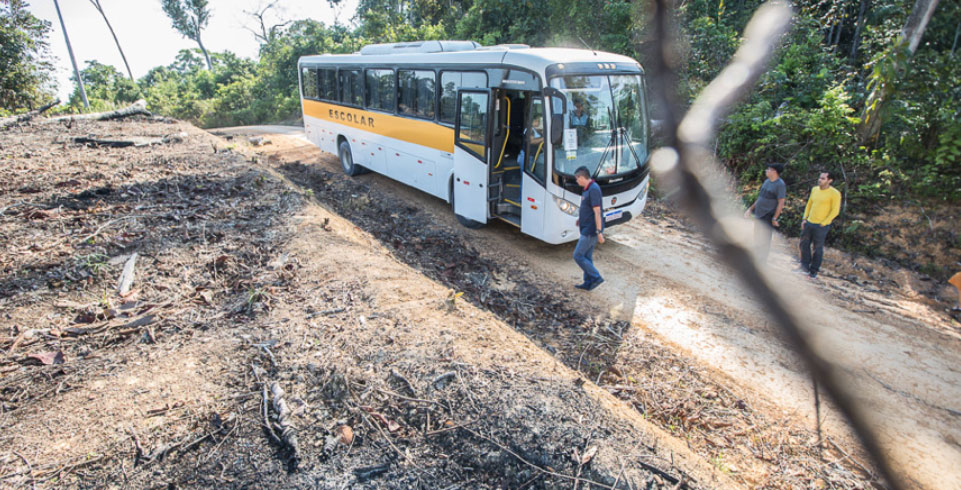
Arrival is scheduled for nine in the morning, but the actual duration of the trip is up to Mother Nature. In an area of heavy rainfall and great environmental complexity (it’s the world’s largest rainforest!), torrential rains, fallen trees over 60 meters tall, or unexpected encounters with anacondas, agoutis, pacas, and other animals can delay or even prevent classes from starting. By the end of the 2019 school year, in August, there had been thirty-two days without classes due to weather conditions, most of them because rain had made the road impassable. Nevertheless, the team does everything possible to make up for the lost days.
José Adiel Barbosa, who has been driving the school bus for two years, has lost count of how many times he’s had to use his ingenuity to get the children to safety when a storm breaks out, to steer animals off the road, or simply to navigate a rough stretch of road that forces him to “burn” the tires and kick up a huge cloud of dust as he climbs the hillsides. “In a rural school, even the driver has to give it his all,” says Andréa. “Someone less committed would turn around as soon as the first raindrop fell.”
“I wouldn’t trade it for anything in the world.”
After completing their journey through the jungle, the staff and the 67 students—ranging from preschool through 9th grade—finally arrive at the school, a wooden building surrounded by greenery. The windows have no glass, and there is no second story. Inside, four small classrooms, the principal’s office and administrative offices, the supply room, the kitchen, the dining hall, and a shared restroom for boys and girls make up the limited infrastructure available. There are no handrails or guardrails on the stairs connecting the ground floor to the first floor, so the children cannot go upstairs. The principal, with the help of the staff and the community, is working to make improvements to the facilities, such as replacing the roof tiles and building another restroom and a small playground where the children can play. Classes are mixed-age, with boys and girls from various age groups.
The school has no landline, and cell phones do not work because there are no cell towers. Internet access is possible using the Municipal Department of Education’s mobile device when electricity is available, but power outages are frequent, and sometimes both the school and local residents can go several days in a row without power.
The challenges inherent to rural life strengthen the bond that the principal, the eleven teachers, the cook, the driver, the monitor, and the general services assistant have forged with the school and its students—and vice versa. “I love this place. I’ve found my place at this rural school, and I wouldn’t trade it for anything in the world,” says Simone Pantoja, who has been teaching first through fourth grade for four years.
Just a few minutes of interaction with the students is enough to understand why the teacher and her colleagues feel this way. Living in an area where the bus to Manaus runs only once a week, where no one owns a car, and where the infrastructure is rudimentary, the children appreciate everything the school offers them—from the chance to study and overcome illiteracy—a problem that affects many of their parents—to the hot meals they enjoy every day.
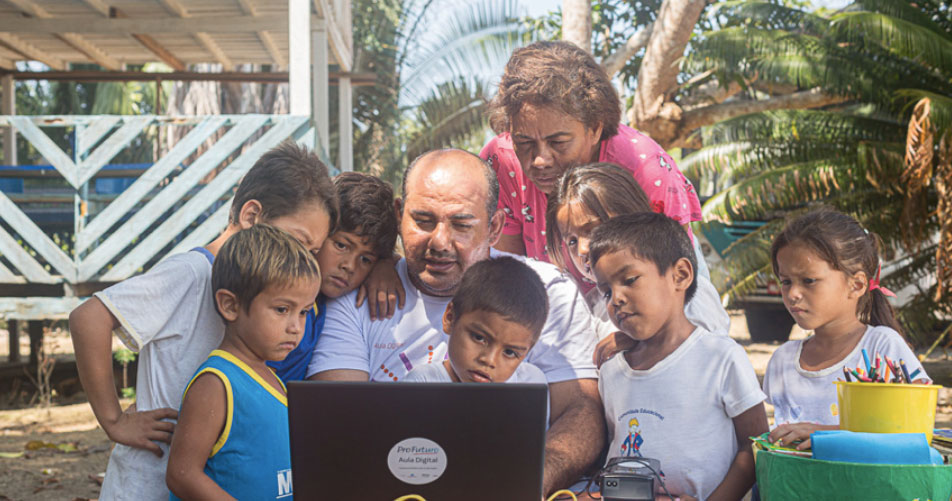
In Infant Education, as there is no classroom available, the class takes place in the dining room, which is on the school porch or on the lawn, in the shade of the copoazús. No toys in sight. Outdoors, teacher Gutnéa Nunes de Azevedo’s students play in circles, take off their shoes, climb trees and take advantage of the most awaited activity of the week. “The class of the tablet is the one I like the most,” explains one of the children, Raí, about ProFuturo’s Digital Classroom. “And the food, too.” Full of pride, he tells us that he is eight years old, but his height and the innocence of early childhood reveal that he is actually four years old.
Nine other children are in the same class as Raí and they all love the “tablet class”. Among them is Viviane, her five-year-old cousin, and her little brother, Josué, who is four. While taking pictures with the device, Josué explains that one day he went fishing with his dad and caught “a fish the size of the school” to eat with his family. On lucky days, when he goes fishing with his father, the boy boasts of having caught crabs and piaba fish.
Taking advantage of the fact that the conversation is about animals, her classmate Ana Sofia, 4, shows the wound that Chimba, the monkey she has as a pet, inflicted on her leg. “But I still love it,” she quickly adds. They all like tablet games and playing with dolls. Football also plays an important part in their leisure time and both boys and girls play it without hesitation.
The life of the little ones unfolds around the Branquinho River Branch. They rarely visit other places and many of them do not know Manaus. Someone who has visited the state capital is Vivi: “I liked it a lot, I ate ice cream and sorbets,” says the girl, who in addition to Manaus also went to Codajás, her mother’s birthplace, where she bathed several times in the waterfalls.
Rayciane, Raí’s eight-year-old sister, also liked Manaus. “There was a park and I played a lot,” she recalls. Her little brother has never been to the big city and does not want to imagine what it is like. “I have never been, how would I know?” he argues.
Like other children, Rayciane gets up early to help her mother, who has three other children and is pregnant with her fifth. Unlike her daughter, she never learned to read. Rayciane does everything at home. “I carry the little ones, do the dishes and cook,” she says and adds that her speciality is pasta. The family shares a one-room wooden house on the edge of the road, with the sides of the porch closed off by pieces of plastic.
Viviane, Josué and their four brothers (Amilton, Orleam, Cristiano and Evertom) do not go to school alone. Their mother, Salvani Marinho, 31, does her best to go with them, and sometimes her husband, who goes by the name of Palhinha, joins them. Salvani enjoys the opportunity to study for the first time, by attending fifth-grade class or taking advantage of the principal’s tutoring in the little time she has between assignments.
Salvani is originally from Codajás, the “land of the açaí,” a municipality of 28,000 inhabitants, 300 kilometres from Manaus. She was unable to study because her father prevented her from doing so and put her to work at the age of eight. “I was carrying a 20-litre jerry can of water by myself and preparing food for a lot of people,” she says sadly.
His memories of his childhood and adolescence are very tough. “My father never let me study. I learned to read by myself, with the Bible, but I did not know how to write. I would see the girls go to school and I would cry,” she recalls. They also did not always have something to eat. When things got bad, her mother, whom Salvani loved dearly, would kill an alligator or some other animal to feed the family.
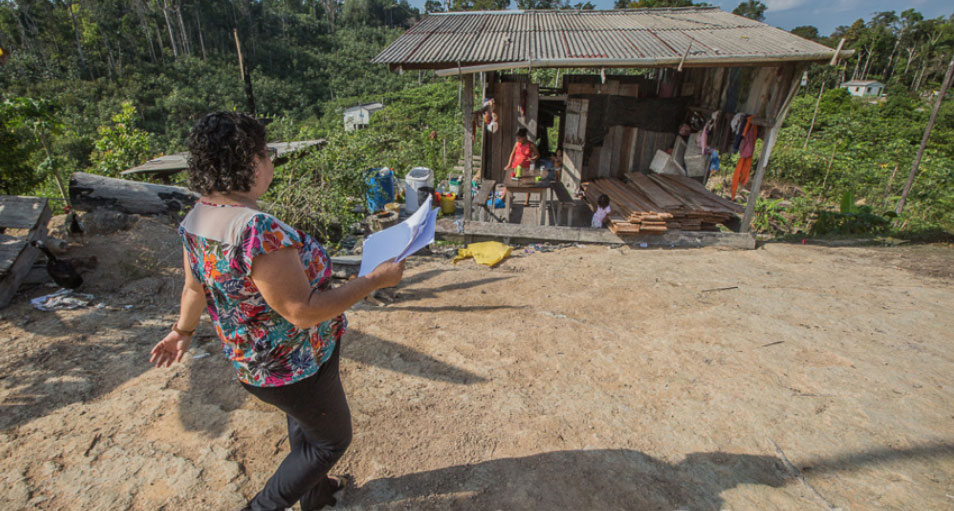
Today, both she and her husband are farmers. With him and his six children, aged fifteen to four, they live in a wooden house on a half-hectare plot of land a few miles from the school, where they raise chickens and grow bananas, cassava and eight hundred feet of black pepper. In addition to working on the farm and caring for her children, she spends much of her time caring for her 110-year-old father-in-law, who lives with them. All this hustle and bustle does not stop her from applying herself to her studies and making sure her children do the same. Anyone who gets under a seven gets a good scolding. “They’re getting an opportunity I never had. If they don’t take advantage of it now, they will regret it later,” the mother explains.
She fulfils her purpose of studying in spite of her parents’ strong resistance, who expected her to stay at home and work. However, Salvani does not give up and has the support of her husband, who studied up to the sixth grade. “We help the children with their homework. He studied more than I did, but I think I understand the questions better,” she celebrates.
Salvani has a hard time finding happy memories, but she believes that the time when she finally managed to study has been the one that has marked her the most. “I’ve never been so happy. The teachers bet on me, encouraged me and supported me,” she explains. “Some people, even if they’re not your family, can give you so much more than what a parent can.”
Her main goal right now is to pass the exam to get her 5th grade diploma. The teachers and the principal are confident that she will succeed. When she finishes primary and secondary school, she wants to continue her studies and dreams of becoming an agricultural engineer. If she does not make it, she would also like to be a reporter and travel wherever she is sent. “Look at the girls from ProFuturo who have come to produce the book. They are from São Paulo and they came all the way here through the Branquinho River branch to do their work!” she explains enthusiastically. Keep it up, Salvani. As you learned in school, you have the right to believe that dreams come true and to fight for them.