
In just three years, artificial intelligence has travelled in education a path that other technologies took decades to complete. The power of the technology overtook us with unusual speed. The first classroom experiments coexisted from the outset with debates about assessment, authorship, teacher training and new digital skills.
Guidelines had to be developed, boundaries established and decisions made while we were still trying to understand the scale of the change. Now, it seems that, with the urgency behind us and reflection underway, the conversation is beginning to shift its focus, and the latest reports from experts and international organisations appear to confirm this.
Una parte creciente del debate parece estar concentrándose en la capacidad de los sistemas educativos
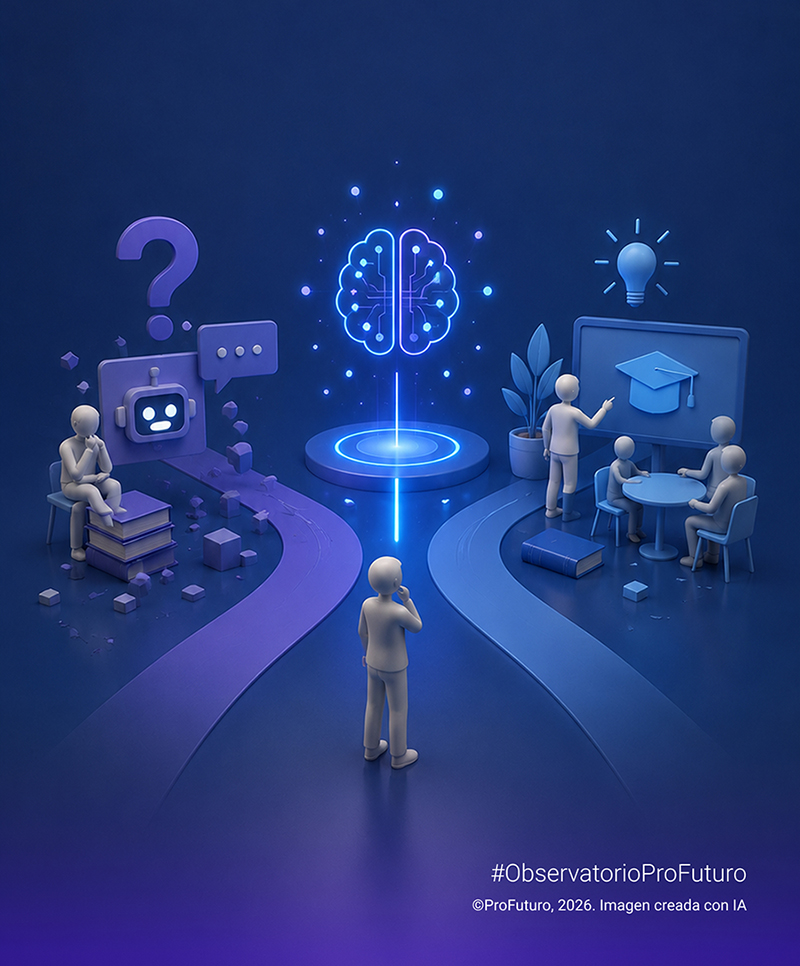
An increasing share of the debate now seems to be concentrating on the ability of education systems to decide when a technology deserves to be used, how its effects should be evaluated and who is accountable for its consequences.
Five Changes in the Conversation Around Educational Technology and AI
The convergence is striking. International organisations, research centres, public administrations and specialised companies observe different realities, work with different methodologies and respond to priorities that are not always the same. Yet when one reads together the reports published in recent months, certain questions begin to appear with a frequency that is difficult to ignore.
This does not amount to a consensus or a shared agenda. Nor does it mean that all institutions are proposing the same answers. What is interesting is something else: the language is beginning to resemble itself and concerns are starting to converge. Artificial intelligence remains the immediate object of discussion, but the conversations increasingly resemble less a debate about tools and more a discussion about what education systems need to know how to do in order to make sensible decisions about them.
Let us look, then, at the five trends we have observed.
From Initial Enthusiasm to Evidence
The first reaction to artificial intelligence was shaped by the discovery of its capabilities. The possibility of generating texts, summarising documents, producing images, designing activities or holding complex conversations captured much of the attention of schools, teachers and governments. As has happened in other phases of educational technology, novelty alone seemed sufficient to justify interest.
Some of the most recent documents suggest, however, that this phase is beginning to run its course. HolonIQ places evidence and impact measurement among the elements that will define the next stage of the education market. The European Commission insists on the need to assess the real effects of applications before their widespread adoption. UNESCO calls for monitoring mechanisms capable of identifying benefits, risks and unintended consequences.
The difficulty is that proving that a technology works is considerably more complex than public debate often assumes. A tool may improve academic outcomes while simultaneously increasing teachers’ workloads. It may reduce administrative tasks without producing noticeable improvements in learning. It may benefit certain students while creating difficulties for others.
Before measuring the impact of an innovation, it is necessary to decide which outcomes an education system considers valuable and what kind of evidence it is willing to accept as proof that those outcomes have genuinely been achieved.
From Adoption to Impact
For much of the past few decades, the incorporation of technology was often interpreted as an indicator of modernisation. The presence of devices, platforms or digital resources almost automatically became a sign of progress. Artificial intelligence is forcing us to ask somewhat different questions.
Attention is beginning to shift from the mere existence of the tool to the educational problem it is intended to solve. The introduction of a conversational assistant, an intelligent tutoring system or an automated content generation platform no longer makes sense in itself; instead, it depends on its ability to respond to the concrete needs of teachers and students.
The change may appear subtle, but it has important consequences. It forces education systems to define objectives, identify problems and establish evaluation criteria before making technological decisions. It also introduces a degree of discipline into a field that has long been accustomed to operating somewhere between high expectations and results that are difficult to measure.
The conversation is therefore beginning to move from adoption towards impact: what specific improvement is expected and how it will be verified that it has actually been achieved.
From the Tool to the System
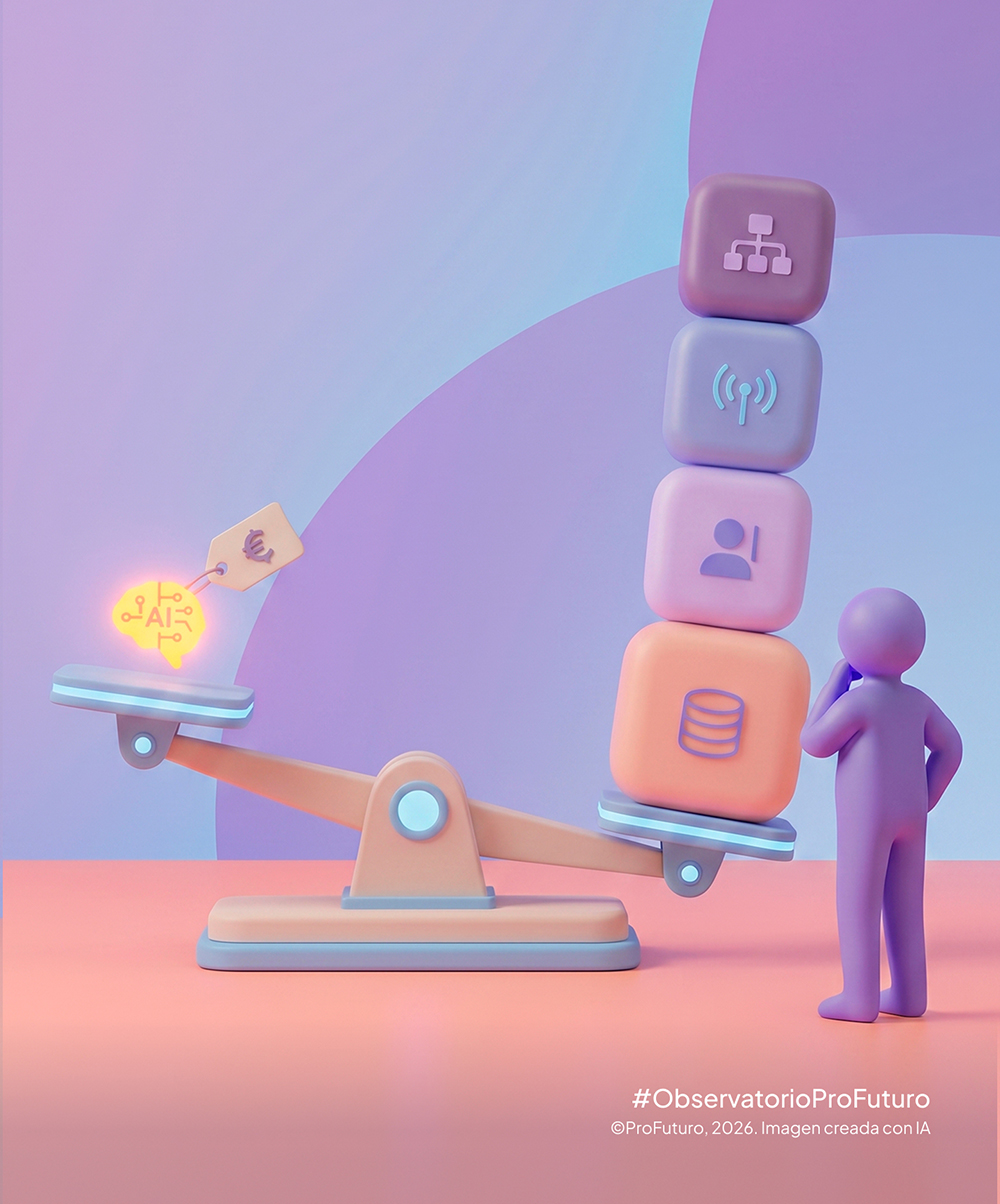
This is probably where many recent reports converge most clearly. The regional diagnosis produced by Fundación Ceibal points to challenges related to institutional coordination, policy continuity and management capacity. Similar concerns emerge elsewhere. The World Bank stresses the importance of teachers’ professional judgement and initial teacher education, while the OECD and SUMMA have long highlighted the decisive influence of school context and implementation conditions on any process of educational innovation.
Because we know that technologies do not produce results in a vacuum. The same tool can have very different effects depending on the curriculum, the assessment system, the degree of school autonomy, teacher training or the existence of leadership capable of supporting change.
The recent history of education is full of technologies that promised to transform classrooms but ultimately had a much more modest impact than expected. In many cases, the problem did not lie in the limitations of the technology itself but in the difficulty of integrating it into organisations designed to operate in a different way.
Artificial intelligence appears to be reinforcing that lesson: the performance of a technology depends as much on the capabilities of the system adopting it as on the technical characteristics of the technology itself.
From Innovation to Governance
Governance scarcely appeared in the early discussions about educational artificial intelligence. Today, it is difficult to find an international report that does not mention concepts such as human oversight, transparency, data protection, traceability or accountability.
This is no coincidence. The greater a technology’s ability to influence important educational decisions, the greater the need to establish rules governing its use and mechanisms that allow its effects to be reviewed.
UNESCO has repeatedly stressed the need to maintain human control over decisions affecting students’ learning and wellbeing. The European Commission is devoting increasing attention to risks associated with algorithmic bias, the opacity of certain systems and the processing of personal data in educational settings.
Governing a technology does not simply mean regulating it. It also means deciding who is responsible when errors occur, according to which criteria outcomes are evaluated and which procedures make it possible to correct mistaken decisions.
The conversation about artificial intelligence is therefore beginning to incorporate questions that traditionally belonged more to the realm of public policy than to that of technological innovation.
From the Provider to Public Capacity
There is one final shift that appears in many current discussions about digital transformation. Education systems have been purchasing technology for decades. The arrival of artificial intelligence is demonstrating, however, that acquiring tools represents only a small part of the issue.
Selecting them requires technical capacity to compare solutions and demand standards. Integrating them requires pedagogical and organisational knowledge. Evaluating them requires data and monitoring mechanisms. Replacing them when they stop working or create excessive dependency also requires institutional autonomy and decision-making capacity.
Much of the current debate around public platforms, interoperability and technological sovereignty stems precisely from this concern. Because what matters is not so much what a particular provider can offer, but what an administration needs to know how to do in order to govern technology over time and prevent decisions taken under the pressure of novelty from shaping an education system for years to come.
Tools change rapidly. Institutional capacities, by contrast, take much longer to build. Increasing numbers of reports seem to agree that much of the success of digital transformation will depend less on the speed at which new technologies emerge than on the capacity of institutions to decide how to use them.
Education systems are beginning to assume that no technology, however sophisticated, can replace the need to define clear objectives, build institutional capacities or establish accountability mechanisms.
AI as an Accelerator of Old Questions
It is important not to attribute more novelty to artificial intelligence than it actually deserves. Many of the questions now associated with it have accompanied the digital transformation of education for decades. Schools had already faced technological promises that were difficult to evaluate, platforms adopted more quickly than they were reflected upon, pilot programmes that failed to become established and purchasing decisions that shaped school organisation for years. AI did not create these problems. But it has accelerated them.
The difference lies in the scale, the speed and the type of decisions now at stake. A device could remain underused in a classroom. A platform could be used only marginally. An artificial intelligence system, by contrast, can intervene in content production, assessment, student guidance, administrative management or relationships between teachers and families. Its presence affects many layers of the system simultaneously.
That is why old questions are returning with renewed force: how innovations should be evaluated before they are scaled, what can be done to avoid dependence on a single provider, how technology, curriculum, teacher training and assessment policies can be coordinated, and which public capacities are needed to support processes that cannot be solved through a purchase or a user guide.
Artificial intelligence therefore acts as a kind of stress test for education systems. Although it neither replaces previous problems nor inaugurates a completely new agenda, it forces us to look at them with less room for improvisation.
Perhaps that is why the current debate becomes more interesting when read beyond the tool itself. What is at stake is not only the introduction of a particular technology, but the ability of education systems to learn from their own decisions, correct them in time and build public criteria regarding what deserves to enter schools and under what conditions.
The Maturity of Digital Transformation
For a long time, the digital transformation of education was interpreted primarily as a problem of access. The priority was to connect schools, distribute devices, deploy platforms and ensure that teachers and students could use digital tools under reasonable conditions. That agenda remains important in many contexts and is still far from resolved in large parts of the world.
However, recent discussions seem to point towards a different set of challenges. The questions that are beginning to recur have less to do with the availability of technology and more with the conditions necessary to use it in useful and sustainable ways. What matters is the ability to evaluate results, coordinate policies, train professionals, negotiate with providers, protect rights and review decisions when evidence fails to support initial expectations.
In a sense, this could be interpreted as a sign of maturity. Education systems are beginning to assume that no technology, however sophisticated, can replace the need to define clear objectives, build institutional capacities or establish accountability mechanisms. Artificial intelligence does not eliminate these responsibilities. In many cases, it amplifies them.
Perhaps that is why some of the concepts appearing most frequently in recent international reports do not come from the traditional vocabulary of technological innovation. They speak of evidence, governance, public capacity, human oversight or institutional coordination. These are less spectacular terms than those associated with technological disruption, but they are probably closer to the conditions that allow innovation to produce lasting effects.
Artificial intelligence will continue to evolve rapidly, and it is reasonable to assume that the tools available five years from now will be very different from those we have today. What is far less likely is that the capacities of the institutions responsible for deciding how to use them will evolve at the same pace. The challenge, therefore, will lie not so much in anticipating which technology will next arrive in classrooms, but in developing the capacities needed to decide which technologies deserve to remain there, for what purposes and under what conditions.