When the Problem Lies in the Learning Environment

A student may fully understand a concept and still be unable to explain it in writing. They may become lost when faced with instructions containing too many steps, interpret an abstract question literally, or freeze in front of a blank page. For some students with autism, ADHD, dyslexia, dysgraphia, or dyscalculia, many of the challenges they face at school emerge in the space between what they know and the way they are expected to learn, participate, or demonstrate their knowledge.
A new OECD report, AI to Support Neurodivergent Learners in Vocational Education and Training, examines how artificial intelligence and other advanced technologies can support neurodivergent learners. Although the study focuses on vocational education and training, many of the barriers it identifies—and several of the solutions it describes—are equally relevant to primary and secondary education. The report draws on more than 50 interviews with teachers, researchers, developers, employers, and specialists in disability and neurodiversity. Let us take a closer look.
Adapting Learning Materials Without Changing What Students Are Expected to Learn
One of the most immediate applications of artificial intelligence is adapting the way content is presented without changing what students are expected to learn. In practice, this means rephrasing an explanation, simplifying instructions, providing an additional example, or generating different versions of the same activity to accommodate different learning profiles. The report notes that these tasks account for a significant portion of teachers’ preparation time and that AI can speed up this initial work.
One of the examples highlighted by the OECD comes from a secondary school in Cyprus. Its principal, Eleni Damianidou, explains that teachers use artificial intelligence to rewrite questions for students with autism spectrum disorder, replacing language that is overly general or abstract with wording that is more concrete and grounded in real-life situations. The tool produces an initial draft, but teachers are responsible for reviewing and validating the final version before using it in the classroom.
OCDE report also describes teachers using generative AI tools to prepare multiple versions of the same worksheet or adapt materials to different levels of understanding. The goal is not to create different activities for every student, but rather to remove obstacles that may prevent learners from accessing the same content. A clearer explanation, instructions broken down into smaller steps, or a worked example can help students focus their effort on the concept they are expected to learn instead of on deciphering the way the task has been presented.
Adapting learning materials is probably the most accessible use of artificial intelligence in education. It also best reflects one of the report’s central ideas: technology is most useful when it addresses a specific learning need, rather than attempting to replace teachers’ professional judgment.
Reading a Text Does Not Always Mean Accessing Its Content
In the same classroom, two students may receive the very same document while facing entirely different tasks. For one student, the main challenge is understanding the ideas. For another, it is decoding the words, maintaining attention, or interpreting figurative language before learning can even begin. This is why many of the tools examined by the OECD are designed not to change the content itself, but the way students access it.
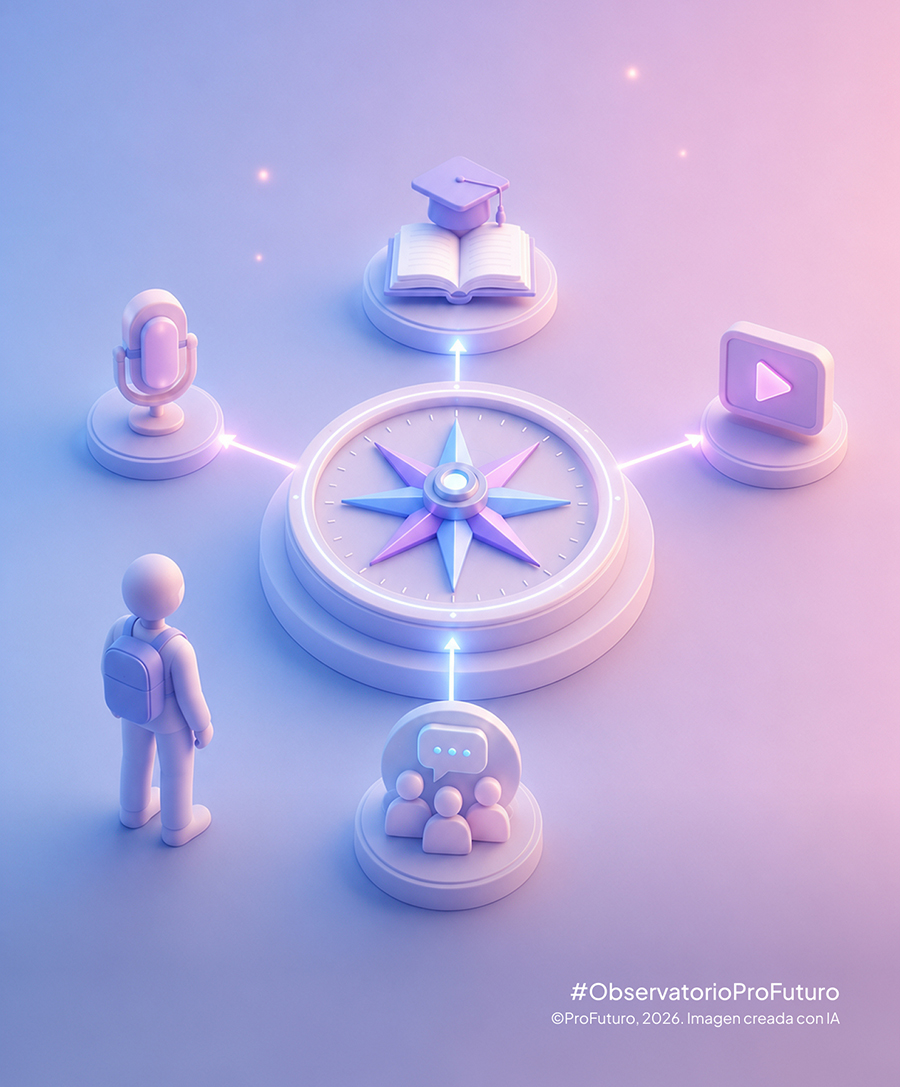
Text-to-speech applications are among the most established examples. Tools such as Microsoft Immersive Reader and Read&Write allow students to listen to a text while following it visually, adjust spacing between words, highlight passages, or modify screen contrast. Many of these features have existed for years, but advances in language models and cloud computing have significantly improved the naturalness of synthetic voices, the accuracy of speech recognition, and the quality of automated transcription.
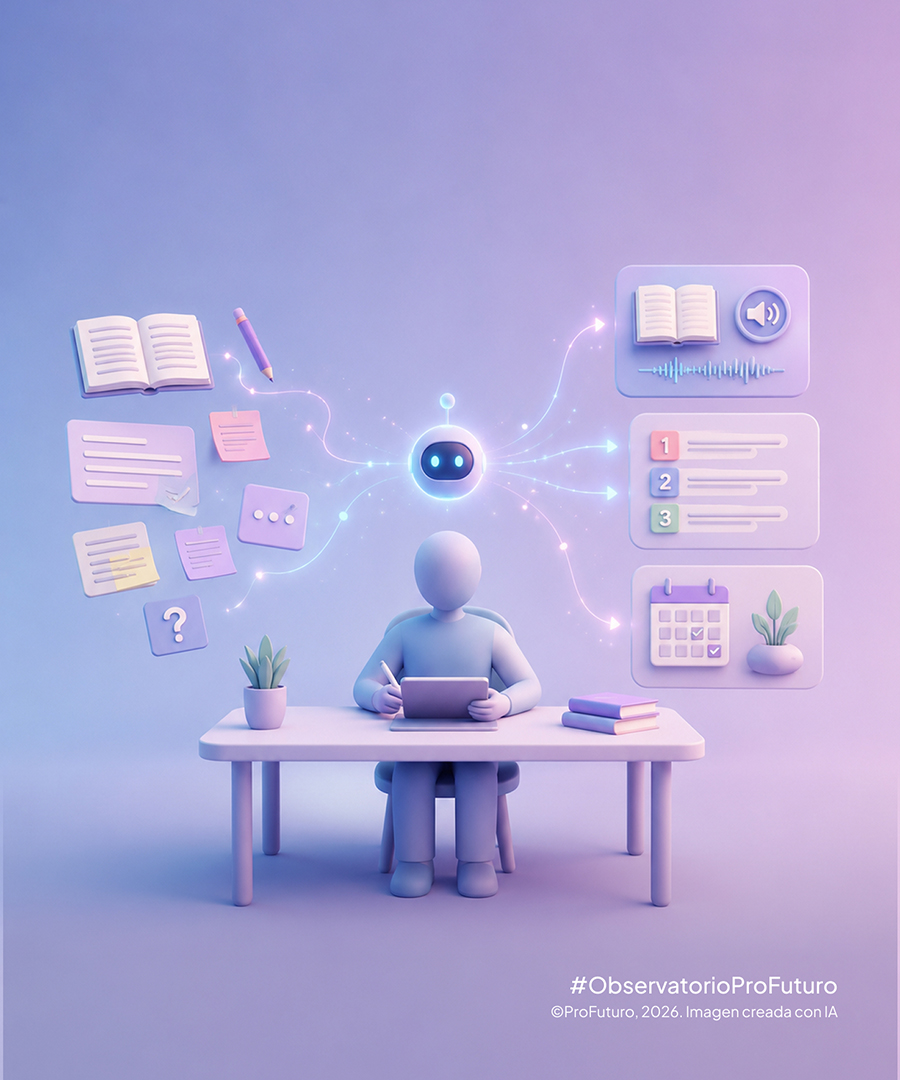
The report also describes how some students use conversational AI assistants to interact with learning materials. Rather than simply reading a text, they can ask a chatbot to explain a metaphor, clarify a cultural reference, or rewrite a paragraph using simpler language. Others generate multiple-choice quizzes from a chapter to check their understanding or convert their notes into audio files they can listen to while reviewing.
The OECD stresses, however, that these tools are not a substitute for reading comprehension. Their purpose is to remove barriers that make content difficult to access when the skill being taught or assessed is something else. A student may need support decoding a text while still being perfectly capable of analyzing a historical event or solving a scientific problem. The value of technology therefore depends on distinguishing between the obstacle and the learning objective.
When the Challenge Is Not Understanding, but Staying Organized
Knowing what needs to be done is not always enough to get it done. Remembering the steps in a task, planning time, setting priorities, or maintaining attention until a task is completed are all processes known as executive functions. For many neurodivergent students—particularly those with ADHD or autism—these skills can represent a daily challenge that affects both learning and participation in school life.
The report identifies this as one of the areas where artificial intelligence offers the greatest potential. Unlike other educational technologies that focus primarily on content, the goal here is to help students organize their work. AI can break a complex assignment into smaller steps, generate to-do lists, set reminders, propose study schedules, or adjust planning when circumstances change.
Among the examples highlighted by the OECD is PASTA AI, a tool developed by Hull College in the United Kingdom. The system analyzes the information available about each student and generates recommendations for teachers on the most effective way to present an activity, while also providing personalized support for planning and monitoring tasks. Its purpose is not to make decisions on behalf of teachers, but to help ensure that adaptations reach the students who need them more quickly and consistently.
The report also describes conversational assistants capable of answering questions about timetables, deadlines, or pending assignments. Although many of these applications were originally developed for vocational education students, their functions can easily be transferred to any educational setting. Receiving an immediate answer about what to do next or a reminder of the next step in an assignment can prevent students from losing track of the activity and having to start over.
Rather than teaching subject content, these tools help students manage the process of learning. And for some learners, that distinction can be just as important as the explanation of the subject itself.
Rather than asking what students must do to adapt to an education system designed around a single learner profile, the report encourages educators and policymakers to consider how the learning environment itself can better adapt to the diversity of those who learn.
Practising Before Facing the Real World
Some skills cannot be learned from a textbook alone. Holding a conversation, interpreting non-verbal communication, navigating a job interview, or asking for help when a problem arises are all skills that must be learned through practice. For some neurodivergent students, however, practising these situations can be particularly challenging.
The OECD report describes several experiences in which artificial intelligence creates safe environments for rehearsing these kinds of interactions. Unlike real-life situations, which may generate considerable pressure, these systems allow students to repeat a conversation as many times as necessary, make mistakes without consequences, and receive immediate feedback.
One example is QTrobot, a humanoid robot used in a variety of educational programmes to develop communication skills in children and young people with autism spectrum disorder. Through guided conversations, facial expressions, and progressively structured activities, the robot helps students practise recognizing emotions, taking turns in conversation, and maintaining eye contact. The interaction is always supervised by a professional, who defines the learning objectives and adapts the activities to each student.
The report also mentions other conversational assistants capable of simulating job interviews, meetings, or everyday conversations. Although many of these systems were originally designed to support the transition into employment, the same logic applies to compulsory education. Practising how to ask for clarification in class, start a conversation with a classmate, or respond during an oral presentation can help reduce the anxiety that these situations often generate for some students.
The OECD nevertheless emphasizes that these tools are not intended to replace human relationships. Their purpose is to provide a space for practice that helps students build confidence before transferring those skills to real-life situations, where the support of teachers, families, and peers remains indispensable.
Learning in an Environment Where Mistakes Have No Consequences
Some skills require more than an explanation. Operating machinery, working in a workshop, following safety procedures, or carrying out laboratory activities all require students to perform tasks in real-world settings. Yet that first encounter can be especially demanding for students who experience sensory overload, anxiety, or difficulty processing multiple stimuli at the same time.
For this reason, the report devotes considerable attention to immersive technologies such as virtual reality and augmented reality, sometimes combined with artificial intelligence systems. Their main advantage is that they allow students to practise a task as many times as necessary before facing the real situation. The environment remains controlled, mistakes carry no real-world consequences, and the level of difficulty can be increased gradually.
Among the experiences examined is a programme developed in Finland for students with special educational needs that uses immersive simulations to rehearse vocational tasks in a safe environment. The report also highlights SANDI, a driving simulator designed to help people with autism practise driving-related skills before getting behind the wheel of a real vehicle. Although both examples come from vocational education, they illustrate an idea that is equally relevant across all levels of education: learning by doing, without allowing fear of making mistakes to become another barrier to learning.
Although these technologies are still relatively limited in their adoption because of their cost and resource requirements, the OECD considers them one of the areas with the greatest long-term potential. Not because they replace real-world experience, but because they allow many students to approach it better prepared and with greater confidence.
What Artificial Intelligence Still Cannot Solve
Throughout the report, the OECD is careful not to present artificial intelligence as a universal solution. In fact, a substantial part of the publication is devoted to explaining why these technologies must be used with caution. AI can make certain tasks easier, but it can also introduce new risks if it is used without appropriate supervision, clear pedagogical objectives, or sufficient safeguards to protect students.
One of the main concerns relates to privacy. Many applications process highly sensitive information about students’ learning, their difficulties, or the support they require. The report warns that this type of data demands particularly strong protection and that schools need to understand exactly what information these tools collect, how it is stored, and who has access to it.
The OECD also warns against becoming overly dependent on automated systems. A recommendation generated by artificial intelligence may be useful when preparing an activity or adapting learning materials, but it should never replace a teacher’s professional judgment or become the sole basis for educational decisions. AI models can make mistakes, misinterpret a student’s needs, or reproduce biases embedded in the data on which they were trained.
Another challenge is far more practical: unequal access. Not all schools have the same technological infrastructure, and not all teachers have the time or the training required to integrate these tools effectively into their practice. The report argues that the value of artificial intelligence depends less on the sophistication of the technology itself than on the education system’s ability to integrate it in ways that make pedagogical sense. Without that preparation, even the most advanced applications risk remaining underused—or widening existing inequalities between schools.
Another Tool, Not a Replacement for Teachers
The report’s main conclusion is deliberately cautious. Artificial intelligence can make learning materials more accessible, help students organize their work, adapt educational resources, and create new opportunities for practice for neurodivergent learners. Yet none of these functions, on their own, removes the barriers these students face or replaces the role of teachers.
The report does, however, propose an important shift in perspective. Rather than asking what students must do to adapt to an education system designed around a single learner profile, it encourages educators and policymakers to consider how the learning environment itself can better adapt to the diversity of those who learn. Within that framework, artificial intelligence emerges as a valuable tool—but only when it addresses a specific learning need, is guided by sound pedagogical principles, and remains firmly under human direction. According to the OECD, that is where its real potential lies, not in the technology itself.