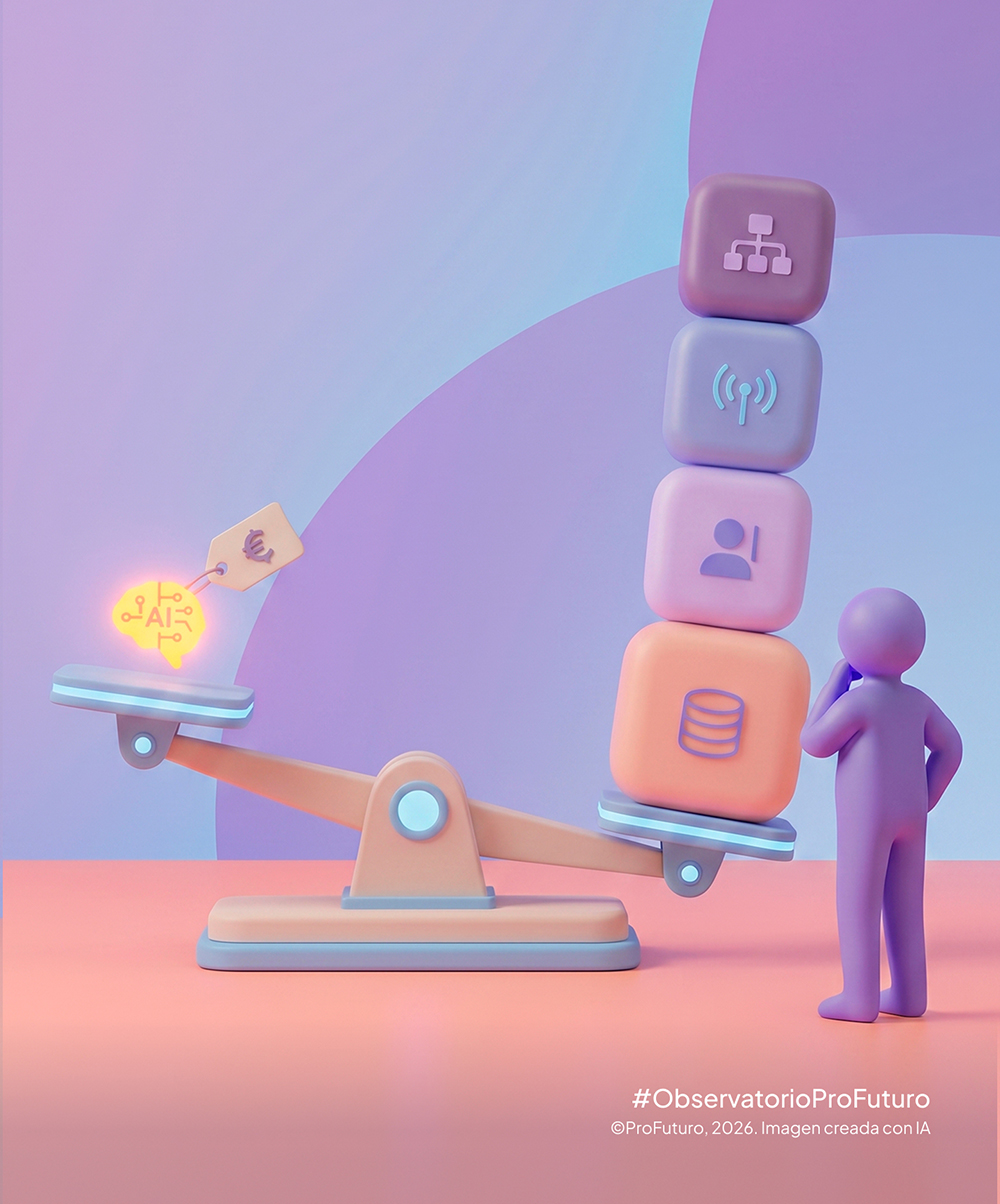

Never before have we written so much. Or so quickly. Or with such ease in finding the exact word, structuring an argument, or polishing a text until it becomes persuasive. Artificial intelligence proposes titles, reorganizes paragraphs, improves style, and suggests ideas with a fluency that would have seemed unimaginable only a few years ago. Everything points in the same direction: increasingly polished writing.
Yet a recent study by researchers at Georgetown University and other U.S. institutions introduces an unexpected twist to that narrative. After analyzing nearly 373,000 university admissions essays written before and after the arrival of ChatGPT, they observed an apparently contradictory phenomenon. Essays produced after the emergence of generative AI employ a broader and more sophisticated vocabulary, yet the ideas they contain are less diverse and increasingly resemble one another. The richer the writing appears, the narrower the conceptual space it occupies.
This finding extends far beyond the realm of writing. University admissions essays are one of the few genres in which each person is expected to demonstrate precisely what makes them different from everyone else: their experiences, their perspective on the world, and the way they think. If even in this context ideas begin to converge, then the issue is no longer one of style. It is an educational challenge.
The study does not demonstrate that artificial intelligence impoverishes human thought. The authors are careful not to make that claim. What they do present is a paradox: improvements in expression may coexist with a reduction in conceptual diversity. From there, the discussion reaches well beyond language models. At a time when millions of people rely on the same tools to write, summarize, argue, or seek inspiration, it is worth asking not only how our writing is changing, but also what may be happening to the diversity of our ideas.
The Study: Greater Lexical Richness, Less Conceptual Diversity
The study, which has not yet undergone peer review, analyzes 372,793 personal essays submitted during the admissions processes of four U.S. universities before and after the public release of ChatGPT in November 2022. Its objective was to determine whether the emergence of generative artificial intelligence had altered the way people write when faced with a particularly significant task: explaining who they are.
To do so, the researchers did not evaluate the quality of the essays or their success in the admissions process. Instead, they measured something different: the semantic diversity of language across three levels. The first examined the variety of vocabulary used. The second assessed the diversity of ideas developed within each essay. The third measured the extent to which each essay differed thematically from the others submitted in the same admissions cycle. This approach was designed to distinguish between the surface richness of language and the conceptual originality of the content.
The results were remarkably consistent across all four universities. Following the release of ChatGPT, essays displayed a more diverse vocabulary, but also a narrower range of ideas and greater thematic similarity to one another. The authors described this phenomenon as “paradoxical homogenization”: texts appear more creative because they make use of richer linguistic resources, even as the underlying ideas increasingly converge around similar patterns.
The research is robust in its design. It combines a large-scale observational analysis with a controlled experiment and highlights a phenomenon that extends well beyond university essays. The convergence of ideas that it documents invites us to look beyond the texts themselves. Are we simply witnessing a standardization of language, or a deeper transformation in the way we construct thought?
The educational value of artificial intelligence depends not on its ability to provide answers, but on how we use those answers.
The Age of the Most Probable Answer
The study’s findings become less surprising when we consider how a language model actually works. Its strength does not lie in understanding the world as humans do, but in identifying patterns on a scale impossible for any individual mind. It has learned by processing billions of words and detecting which ideas tend to appear together, how arguments are typically developed, and which expressions are most likely to follow others. Every response it generates is, fundamentally, a prediction: the continuation that is statistically most likely to fit the context.
This logic explains why artificial intelligence produces such convincing prose. It does not invent from scratch; it reorganizes, combines, and reformulates patterns that already exist. The result can certainly be brilliant. Accurate? Undoubtedly. Surprising? Perhaps.
However, this apparent creativity emerges from following well-traveled paths, not from venturing beyond the map. If millions of people consult tools trained on the same data and optimized to produce the most plausible answers, it is reasonable to assume that many will end up organizing their thoughts in similar ways. Not because AI copies the same text repeatedly, but because it gently steers thinking toward solutions that have already proven statistically reliable.
This homogenization of thought occurs with remarkable subtlety. Every response feels personalized, every conversation appears unique, and every text contains its own nuances. Yet, viewed collectively, the same patterns begin to emerge again and again. That is precisely what the researchers observed in their analysis of university essays: greater richness of expression accompanied by less diversity of ideas.
The Illusion of Originality
Despite the subtle homogenization of thought described in the previous section, the researchers found that essays written in the ChatGPT era were consistently perceived as more creative.
This should not come as a surprise. We tend to associate elegant writing with profound thinking. A well-constructed argument inspires confidence. Polished prose creates the impression that a brilliant idea lies behind it. Form becomes a shortcut through which we judge substance. And, more often than not, we do so unconsciously.
Artificial intelligence exploits this association with extraordinary effectiveness. It can produce fluent, coherent, and persuasive prose because it has mastered the rules of language better than almost any other tool. The result is writing that appears more sophisticated and, therefore, more original. Yet originality depends not only on how an idea is expressed, but also on the novelty of the idea itself. And those two qualities do not always coincide.
A glance at the history of science and culture is enough to illustrate this point. Many of the ideas that ultimately transformed our understanding of the world were not distinguished by particularly elegant wording. What made them extraordinary was that they offered a fundamentally different way of looking at a familiar problem. Their power lay in breaking with established patterns, not in expressing them beautifully.
That contrast takes on new meaning in the age of artificial intelligence. If it is becoming increasingly easy to write like an accomplished author, then the quality of writing alone is no longer a sufficient indicator of creativity. Perhaps the true distinguishing feature is not the ability to produce flawless prose, but the ability to formulate an idea that still bears no resemblance to all the others.
The Value of Unlikely Ideas
From this point onward, the study’s conclusions invite us to reconsider one of education’s most deeply rooted assumptions: that learning consists of finding the correct answer, when in reality the greatest advances in human knowledge rarely began there.
The history of science is full of examples to the contrary. The theories of evolution, relativity, and plate tectonics were all, in their time, highly improbable ideas. The same is true of many educational innovations that we now take for granted. They did not emerge because someone found the most plausible answer, but because someone dared to explore a possibility that departed from the prevailing consensus.
This is perhaps the greatest challenge posed by artificial intelligence. Language models are extraordinarily good at identifying patterns, synthesizing information, and proposing solutions that are consistent with existing knowledge. They are exceptional tools for traveling along well-established paths. Yet the most significant transformations usually occur precisely when someone leaves that path behind and ventures onto another.
Schools have always had a mission that extends beyond transmitting knowledge. They must also create the conditions in which ideas that do not yet exist can emerge. They should enable students to connect concepts that had never before been linked, formulate a crucial question, or discover a solution that was never found in the textbook. This kind of thinking does not arise from accumulating answers, but from having the freedom to depart from them.
For this reason, at this Observatory we argue that the educational value of artificial intelligence depends not on its ability to provide answers, but on how we use those answers. If they become the final destination, the space for exploration may shrink. If, instead, they serve as a starting point for discussion, questioning, and the search for alternatives, technology can broaden our intellectual horizons rather than narrow them.
Thinking in the Age of Instant Answers
The Georgetown study does not demonstrate that artificial intelligence makes us less creative or that it is impoverishing human thought. Its authors are far more cautious than that. What they do show is a phenomenon that is difficult to ignore: the richness of language can increase at the very same time that the diversity of ideas declines.
And this is where the conversation changes. For a long time, writing well was taken as evidence that someone had thought well. Today, that association is beginning to fracture. A flawless piece of writing no longer guarantees that an original idea lies behind it, just as sophisticated language does not necessarily reflect a fresh perspective on a problem. Writing is no longer sufficient evidence of thinking.
Under these circumstances, schools face a different kind of challenge. If artificial intelligence tools make it easy to access information, arguments, and even complete drafts, then the value of learning shifts toward abilities that are far more difficult to automate: interpreting information, building connections between seemingly unrelated bodies of knowledge, identifying contradictions, questioning a persuasive explanation, or defending an original idea even before it appears self-evident.
The answer is not to reject artificial intelligence. Nor is it to turn every school assignment into a race to determine whether a text was written by a person or by a machine. What truly matters is designing learning experiences in which AI expands the space for exploration instead of narrowing it to the most probable answers.
Never before have we had access to such powerful tools for acquiring knowledge. And never before has it been so important to preserve what no database can guarantee: the ability to generate an idea that does not yet belong to the pattern. Because the progress of knowledge does not depend solely on finding better answers. Above all, it depends on ensuring that questions no one expected continue to emerge.