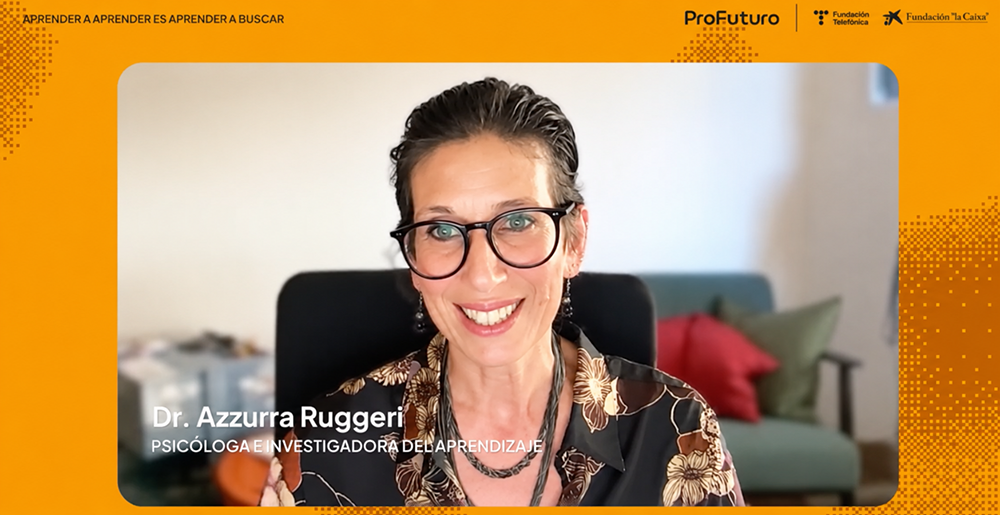
For centuries, education has focused on teaching answers: how to read, write, solve equations, memorize dates, and understand concepts. But learning also requires another essential skill: knowing how to search for information, ask the right questions, and decide which sources to trust. According to psychologist Azzurra Ruggeri, this process of searching is the true engine of learning.
For years, Ruggeri has studied how children and adults search for information when solving problems, making decisions, or trying to understand the world around them. Her research shows that even infants can adapt their search strategies to different contexts, and that successful learners do not stand out because they know more, but because they know how to search more effectively. They do not ask the same questions in every situation. They adapt their strategies, choose their sources more carefully, and recognize when a piece of information genuinely helps them understand a problem.
This perspective also challenges some of education’s long-standing assumptions. If we teach children how to read, write, and solve mathematical problems, why do we spend so little time teaching them how to ask good questions? Why do we almost always assess the answers, but so rarely the quality of the thinking process that led to them? For Ruggeri, learning also means developing strategies for dealing with uncertainty: knowing what information is missing, where to find it, and how to judge whether it deserves our trust.
The rise of artificial intelligence makes these questions even more relevant. At a time when tools such as ChatGPT can generate answers in a matter of seconds, memorization is no longer the key competitive advantage. What will make the difference are skills that are far more difficult to automate: framing good problems, evaluating the reliability of information, integrating new evidence with what we already know, and deciding when it is worth changing our minds.
In this interview, Azzurra Ruggeri reflects on all these questions and offers a different way of thinking about learning. It is an invitation to look at education from an unusual perspective—not through the answers we are able to give, but through the questions we learn to ask.
Don’t miss it.