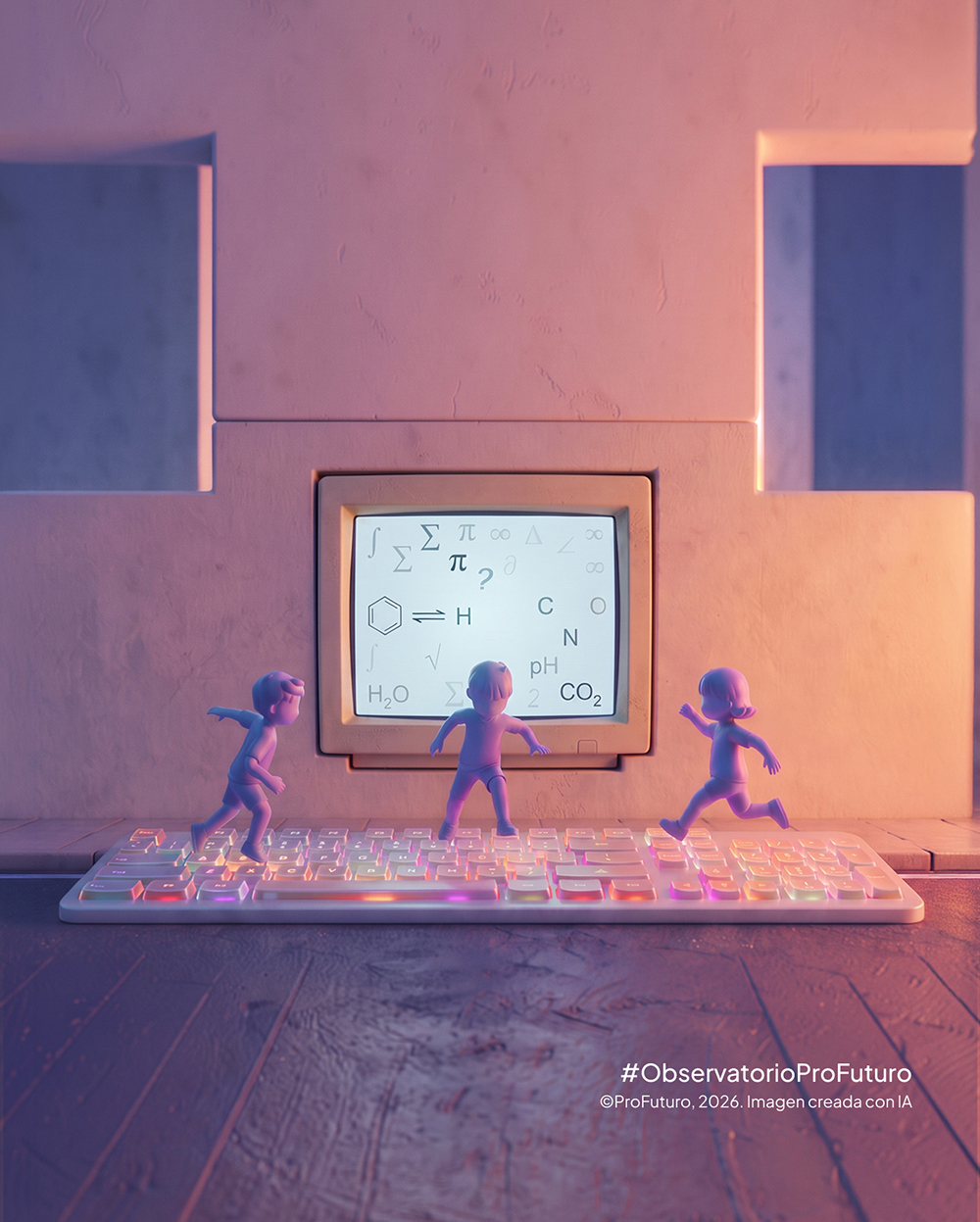
A computer, a wall, and a group of children
On one side of the wall were the offices of NIIT, a company specializing in technology training. On the other was a working-class neighborhood in Kalkaji, New Delhi. In January 1999, Sugata Mitra, then the company’s head of research, decided to open a hole in that wall and install a computer connected to the internet. The screen and a small touchpad were within reach of anyone passing by.
Mitra wanted to observe what would happen when children had access to a computer without an adult teaching them how to use it. The answer began to emerge within hours. The first children approached, touched the screen, tried different options, and called others over. Before long, they had figured out how to browse, open programs, and perform some basic operations. As the researcher himself would later recount, the children learned by watching what others did, exchanging information, and trying things again and again. The computer was in English, a language many of them barely knew.
That first experiment became known as Hole in the Wall and soon spread beyond Kalkaji. Mitra and his team installed similar computers in other parts of India, many of them rural communities with little access to technology and teachers. The results seemed to follow a pattern: wherever a screen appeared, groups of children gathered around it and explored its possibilities together. Over time, some learned to use search engines, games, drawing programs, or educational content without having received formal instruction in how they worked. Mitra began to speak of “minimally invasive education” and to wonder how far this spontaneous learning could go.
The power of the story was impossible to ignore. At a time when the internet was beginning to spread around the world, those children gathered around a screen seemed to anticipate a much larger transformation: the possibility that access to knowledge might change the way we learn and, with it, the traditional role of schools and teachers. The hole in the wall had just become an educational idea.
Learning without anyone teaching
The computer was only one part of the experiment. The other was the children who gathered around it. Mitra observed that learning had a profoundly collective dimension: one child tried something, another watched, a third suggested a different route. The children moved from group to group, shared what they had just discovered, and taught others how to reproduce it. The absence of a teacher giving instructions created space for another way of learning, built through exploration and exchange among peers.
Mitra wanted to find out how far this dynamic could go. He repeated his experiments in different parts of India and presented groups of children with increasingly complex problems. One of the best-known cases took place in Kalikuppam, a village in southern India. There, he asked children between the ages of 10 and 14, who spoke Tamil, to use a computer and the internet to understand basic concepts of molecular biology presented in English. Months later, their test results had improved considerably.
Experiences such as this led Mitra to formulate a more ambitious hypothesis: under certain conditions, a group of children could make progress in learning complex content without receiving direct instruction in it. The key lay precisely in the group. The children searched for information, discussed what they found, compared answers, and drew on one another’s knowledge to keep moving forward.
When Mitra later brought this idea into classrooms, that dynamic took shape in SOLEs, short for Self-Organized Learning Environments. The formula involved several children, a small number of internet-connected computers, and a question capable of sparking their curiosity. Why does it rain? How do animals know when an earthquake is coming? The group decided how to investigate, which sources to consult, and how to construct an answer.
The adult remained part of the process, although in a different role. They posed the questions, observed, showed interest, and asked students to explain their findings. In a talk for BBVA Aprendemos Juntos, Mitra used the image of an unknown forest to describe this role: the teacher invites students to enter and explore it and tells them that they will accompany them. His proposal was beginning to outline an idea that he would later take much further: teaching could also consist of creating the conditions for learning to emerge from the group itself.
From the hole in the wall to the School in the Cloud
The experience that began in Kalkaji grew in scale and ambition. Mitra presented his experiments at conferences around the world, his TED talks accumulated millions of views, and in 2013 he received the TED Prize, worth one million dollars. The money allowed him to launch School in the Cloud, a project through which he sought to explore how far self-organized learning could go in very different contexts.
Seven learning spaces were created, five in India and two in northeast England. They were designed to operate according to the logic of SOLEs: groups of children, internet access, and big questions that they had to investigate together. They could consult different websites, move between groups, share discoveries, and discuss answers. The aim was to observe what happened when a large share of the decisions about how to reach knowledge were left in the hands of the students themselves.
The model also incorporated an unusual figure: the Granny Cloud, a network of volunteers who connected with the children by video call. Many were retired teachers, and their role was to talk to the children, show interest in what they were doing, ask questions, and encourage them to continue. The presence of these “grannies” made clear a feature that was sometimes lost in the more popular version of Hole in the Wall: Mitra’s self-organized learning was never simply a child in front of a screen. There were other children and, increasingly, adults accompanying the process.
The proposal attracted enormous attention. In an interview published by EL PAÍS in 2016, Mitra argued that access to the internet required us to reconsider a school system organized around the transmission of information and memorization. If much of accumulated knowledge was available online, he argued, education should make more room for searching, understanding, connecting information, and solving problems.
That vision fitted well with the enthusiasm surrounding the expansion of the internet. Hole in the Wall had begun by asking what children would do with a computer that no one had taught them to use. School in the Cloud posed something considerably more ambitious: what might happen if schools entrusted a greater share of learning to curiosity, collaboration among students, and their ability to search for answers.
The question was compelling. It was also much harder to answer.
That computer did not reveal a school without teachers. It taught us something far more valuable: children can go further than we expect when we give them tools, peers to think with, and space to find things out for themselves.
How far can self-organization go?
The popularity of Hole in the Wall also increased the questions surrounding its scope. The fact that groups of children were able to handle unfamiliar technology, exchange knowledge, and solve certain problems with little adult intervention was striking. A different question was whether this way of learning could be transferred to different contexts and sustained over time.
Some observations conducted outside Mitra’s team offered a more complex picture. Researcher Payal Arora spent several months studying two Hole in the Wall projects in rural Himalayan communities. She found curiosity, exploration, and collaboration among the children, but also difficulties in sustaining these processes and computer use that was often concentrated on entertainment. The children themselves sometimes asked for more guidance. Arora drew attention to factors that the image of a computer freely available to everyone tended to leave out: the social context, relationships within the community, maintenance of the technology, and the presence of adults capable of helping turn exploration into learning opportunities.
Questions also arose about the research supporting the model. In 2016, the British newspaper The Guardian reported criticism from several specialists who pointed to the small size of some samples and the scarcity of independent, controlled studies. Some of the evidence came from experiments designed or evaluated by Mitra himself and his collaborators, making it difficult to determine how far the results could be generalized to other students, subjects, and settings. Mitra rejected some of these criticisms and argued that his experiments sought to observe how learning emerged in real-world situations.
The discussion, in fact, pointed to a question that the Hole in the Wall experiment could never answer on its own. What can a group of children learn through shared exploration, and which kinds of learning require more explicit instruction? Searching for information, exchanging findings, or trying out solutions are intellectually valuable activities. Building solid knowledge also requires understanding what is found, connecting it to what one already knows, distinguishing a reliable explanation from a mistaken one, and retaining what has been learned so that it can be used later.
The expansion of the internet also exposed a fundamental distinction for understanding the scope of those experiments. Internet dramatically expanded access to information, but access and knowledge are different things. The larger the ocean of available answers becomes, the more important the knowledge needed to navigate it. A question entered into a search engine can lead a child to molecular biology, but understanding what they find there is a different challenge.
Perhaps for that reason, the legacy of Hole in the Wall is more fruitful when understood as an exploration of how much autonomy we can give students, rather than as a complete model of how learning happens. His experiments expanded that space. Subsequent research forces us to ask what we need to place within it.
What remains of Sugata Mitra
Twenty-seven years after that first computer in Delhi, the scarcity of information surrounding the experiment is almost difficult to imagine. A child today can carry in their pocket access to libraries, videos, courses, maps, encyclopedias, and millions of web pages. Artificial intelligence has taken this one step further: it is no longer even necessary to find the information. All it takes is a question to receive an elaborated answer within seconds.
Some of the ideas Mitra formulated back then seem to describe today’s educational challenges remarkably well. He argued that knowing how to search, understand what we read, and find things out would become central skills in education. He also imagined assessments in which students could use the internet and would have to tackle questions for which there was no single answer. In his talk for BBVA Aprendemos Juntos, he identified three abilities that schools needed to incorporate: searching rigorously and quickly, understanding what we read, and learning how to find what we need.
Time has added a difficulty that was barely visible in 1999. Having an answer in front of us does not guarantee that we understand it. A search engine can lead us to a source; an artificial intelligence system can explain photosynthesis, solve an equation, or summarize the French Revolution. Judging those answers requires prior knowledge, the ability to assess sources, and the capacity to detect errors, connect ideas, and formulate new questions. Access multiplies the possibilities for learning, but it also increases the intellectual demands placed on the learner.
Even Mitra gradually qualified the more radical image associated with his experiments. In his BBVA talk, he argues that teachers and schools remain necessary, although they need to change. And the adult figure appears again and again in his own accounts: posing questions, accompanying, encouraging, and guiding exploration.
Perhaps that is where the most enduring legacy of that hole in the wall lies. That computer did not reveal a school without teachers. It taught us something far more valuable: children can go further than we expect when we give them tools, peers to think with, and space to find things out for themselves. The question Mitra posed in 1999 remains open. Except that now, surrounded by answers, it feels more urgent than ever.