Azzurra Ruggeri
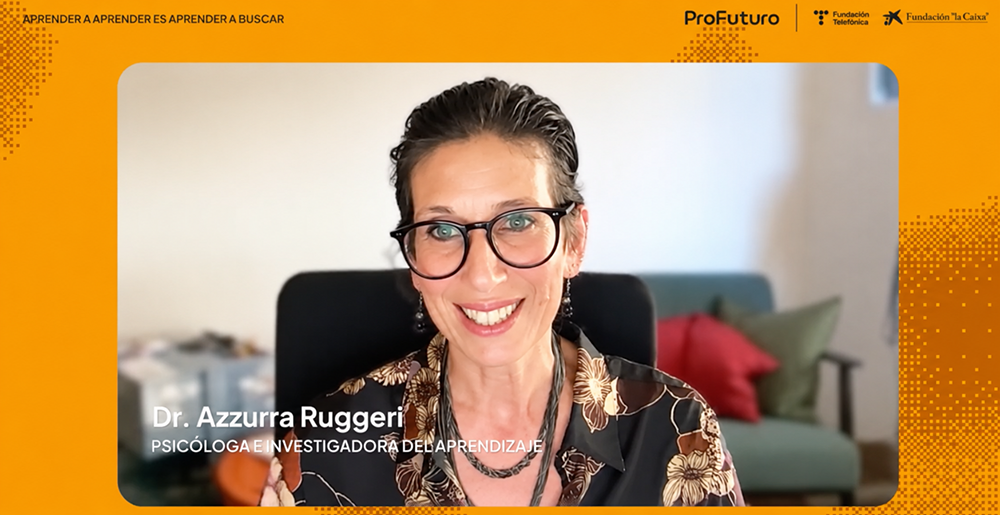
Cognitive psychologist, professor, and researcher, Azzurra Ruggeri has devoted her career to understanding how we search for information, ask questions, and build knowledge.

Sobre Azzurra Ruggeri
< View All ContributorsThe Scientist of Curiosity
Azzurra Ruggeri often says that she believes in coincidences… and, at the same time, that coincidences do not exist. “Everything is connected,” she says. Perhaps that is why it is so easy for her to trace a thread running through the different stages of her life. Before becoming one of the leading researchers in the science of learning, she was a Scout, later a Scout leader, and, after finishing high school, worked as an educator with children and adults with intellectual disabilities. Without realizing it at the time, that was the beginning of a journey devoted to studying one of the most complex and fascinating human processes: learning.
She studied Philosophy at the University of Pisa, where she first became interested in how people think, reason, and make decisions. That curiosity led her to specialize in cognitive and developmental psychology, earning two PhDs—one in Cognitive Science from the University of Siena and another in Psychology from Humboldt University of Berlin. Her academic career has taken her to the University of California, Berkeley, the Max Planck Institute for Human Development, and the Technical University of Munich (TUM), where she is currently Professor of Cognitive and Developmental Psychology. She also directs the iSearch Lab, which investigates how children and adults search for information, formulate questions, and learn in contexts of uncertainty.
Her research has helped demonstrate that successful learners do not stand out because they know more, but because they know how to search more effectively. They adapt their strategies, ask more informative questions, and identify the information they need to make sense of the world around them. It is research that brings together psychology, education, and cognitive science with a clear purpose: helping design more effective ways of learning in an increasingly complex world.