

In November 2022, querying a model with performance equivalent to GPT-3.5 cost around $20 per million tokens. Less than two years later, in October 2024, that price had fallen to $0.07. A reduction of around 280-fold.
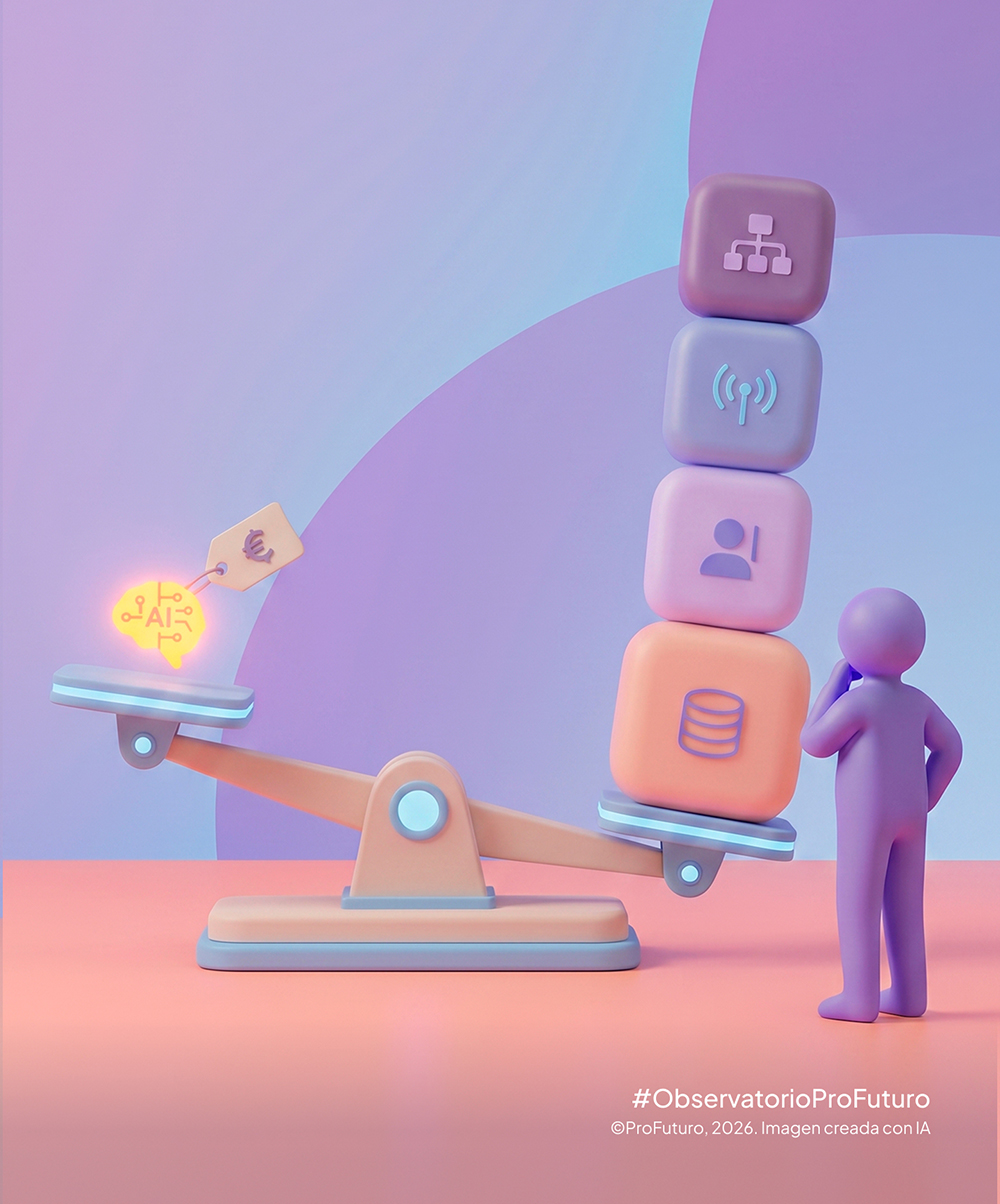
This figure illustrates the extraordinary speed at which the economics of artificial intelligence is changing. Models that only recently required enormous computing capacity can now offer similar performance at a fraction of the price. And all indications are that this trend will continue, although, as some organizations warn, the cheaper AI becomes to use, the more we may use it—and, as a result, total spending may actually increase.
For education, and especially for systems with fewer resources, this decline in cost appears to offer a valuable opportunity. Could technologies that until recently were reserved for countries and schools with greater financial capacity become accessible to schools around the world?
The working paper Costing AI Use in Education in Low- and Middle-Income Countries, published by the World Bank in July 2026, approaches this question from an unusual angle: cost. Its purpose is not to determine whether AI improves learning—an issue on which the authors themselves acknowledge that the evidence remains limited—but to examine what it means, economically, to integrate AI into an education system.
And when the full calculation is made, the price of the model turns out to be only a small part of the problem.
The paradox: where AI could contribute the most, it is hardest to deploy
The possibilities offered by artificial intelligence may be particularly attractive in low-resource educational settings. World Bank report discusses tools capable of personalizing teaching, expanding access to learning materials, reducing some of teachers’ administrative tasks, or helping education systems identify students at risk of dropping out. These applications could be especially relevant where teachers are scarce, classrooms are overcrowded, or information systems are weak.
Yet a look at the material conditions in many schools reveals the other side of that potential.
According to data provided by the UNESCO Institute for Statistics (UIS) and the International Telecommunication Union (ITU), in low-income countries, only 38% of primary and secondary schools have electricity. Just 27% have computers for pedagogical purposes and 23% have internet access for the same purpose. Among the general population, only 27% use the internet, while fixed broadband penetration is around 1%. In high-income countries, by contrast, most of these indicators approach or exceed 90%.
The starting point matters because it determines what must be paid for before an artificial intelligence tool is even purchased. The World Bank explains this through four conditions, which it calls the four Cs: connectivity, compute, context, and competency. In other words: connectivity; computing capacity; data and content suited to the local context; and the skills needed to use the technology. When one of these foundations is missing, the bill rises. When several are missing, introducing AI requires investments that far exceed the cost of the tool itself.
This is particularly important in vulnerable settings. Deploying an application in an urban school that already has electricity, Wi-Fi, computers, and digitally experienced teachers is much easier and cheaper than bringing it to a rural school without a stable connection. If the technology must also work in different languages, align with local curricula, and reach teachers and students with widely varying levels of digital literacy, the requirements increase again.
Equity, in other words, is part of the economic calculation.
The cost of AI begins before AI
To understand why, the report looks at how the economics of educational technology has changed.
In a first phase, introducing technology mainly meant buying products: computers, servers, or software. The investment was substantial, but relatively easy to budget for. A system bought one hundred computers and knew how much they cost. The major risk came later: the equipment aged and eventually had to be replaced.
The expansion of the internet brought a second model: services. Educational platforms, digital content, and cloud-based software began to be purchased through subscriptions. Spending shifted from a one-off initial purchase to recurring monthly or annual costs.
Artificial intelligence adds a third economy: consumption. Every time someone asks a model a question, an inference takes place: the system uses the capabilities acquired during its training to generate a new response. That operation has a cost. A single query may cost very little. But thousands of teachers and millions of students using the technology repeatedly create an ongoing expense that depends on how much it is used and how it is used.
This is why the World Bank describes a shift from an economy of products and services to an economy of tokens. Spending is no longer entirely predictable: much higher use than anticipated can also translate into a higher bill.
And tokens are still only part of the cost. Cloud infrastructure, data transfer and storage, integration with education systems, cybersecurity, privacy protection, bias monitoring, maintenance, and technical support must all be paid for. AI also introduces new recurring expenses, such as monitoring model performance and updating the safeguards needed to use these systems safely.
Added to all this is one of the most important components: teachers. Access to a tool does not guarantee that it will be used. The report cites a forthcoming study in Peru that illustrates this particularly clearly: teachers who received free AI licenses, training on using prompts for lesson planning, and regular encouragement to use the tool achieved a weekly usage rate of only 15%. In Latin America, moreover, estimates cited in the report indicate that 73% of teachers lack the basic digital skills needed for teaching.
Training, guiding, and supporting teachers is therefore also part of the cost of AI. And that expenditure must fit into extremely tight budgets. In low-income countries, annual education spending is around $55 per student, while teacher salaries and other recurring expenses absorb a large share of available resources.
Cheap AI is not necessarily accessible AI: in the most vulnerable settings, reaching those who start with fewer resources is also part of the cost.
The pilot illusion: 500 students are not five million
Now imagine an artificial intelligence project for 500 students. A technology company provides free access to the model. Computing costs are subsidized. An international organization finances the project. A small group of teachers receives training and has access to specialists who can quickly solve any problems that arise. The initiative is implemented in well-connected schools and in a language in which the tool works effectively.
The pilot delivers good results and, on top of that, appears inexpensive. Now try extending it to five million students.
This is one of the report’s warnings: the cost of an AI pilot can be a very poor indicator of what it will cost to take the same intervention to scale. Many of the projects currently being implemented in low- and middle-income countries are heavily subsidized by companies, international organizations, or nonprofits.
As they grow, those exceptional conditions begin to disappear. A company that gives away tokens to 500 students is unlikely to absorb the usage of five million. A standalone application may need to connect to a national education management information system, requiring secure data-exchange systems, cloud infrastructure, and cybersecurity mechanisms.
And equity comes into play once again.
A pilot can select urban schools, work with particularly motivated teachers, and provide dedicated technicians to solve any problems. A national rollout must also reach rural schools, provide infrastructure where none exists, train and support many more teachers and, in some contexts, adapt the technology to minority languages and regional dialects.
The report therefore proposes a different way of thinking about pilots. In addition to testing whether a tool works, they should help systems learn how much it costs to use it: observing how teachers and students actually interact with the technology, how much consumption they generate, what difficulties emerge, and what capabilities education authorities need to develop. A pilot can thus become a laboratory for identifying the conditions required before committing millions to a national rollout.
Starting where AI can be viable
What, then, can an education system do if it wants to harness the possibilities of artificial intelligence but has very limited resources? The World Bank proposes moving forward in stages and offers several options.
Start with teachers
Providing teachers with access to AI requires far fewer users and devices than giving direct access to every student and therefore reduces both initial investment and recurring costs. Starting with secondary or higher education can make the process even easier, since these institutions generally have better electricity, connectivity, and infrastructure.
Think smaller when it comes to AI
While large language models attempt to answer an enormous variety of questions and require substantial computing resources, Small Language Models (SLMs) can specialize in specific tasks. The report identifies several potential advantages for systems with fewer resources: lower operating costs, the possibility of running locally and without a permanent internet connection, adaptation to local curricula and languages, and greater control over data. The trade-off is that they tend to have more limited capabilities for complex reasoning and less general knowledge.
Gradual rollouts that allow systems to test, measure, learn, and recalculate
In a market where models, their capabilities, and their prices are constantly changing, deciding today how much a particular technology will cost to use five years from now is extraordinarily difficult.
The most suitable model for a school or a vulnerable education system does not have to be the largest or most advanced. It may be the one that can address a specific educational need well enough with infrastructure, capabilities, and costs that can be sustained over time.
The cost of reaching the last mile
The logic of economic efficiency encourages systems to start where implementation is easiest: connected schools, digitally skilled teachers, and existing infrastructure. Each additional user costs less and results come sooner. But that same logic can also determine who gains access first to the opportunities offered by a new technology—and who has to wait.
Measuring the cost of AI solely on a per-user basis can therefore be misleading. Reaching a remote school will probably be more expensive than adding another urban school that is already connected. Serving a language with relatively few speakers may require an investment that is difficult to justify in terms of scale. Training and supporting those who start with fewer skills will require more resources. Economic efficiency will tend to favor those who are already better prepared to adopt the technology.
Factoring equity into the calculation means accepting that reaching some students will cost more than reaching others. And that difference is not necessarily an inefficiency: it may be precisely the price of building an education system in which a new technology does not reproduce existing inequalities.
How much does it cost to ensure that those who face the greatest barriers to access can benefit from AI too? That is the measure still missing from many of the calculations we make today about the price of artificial intelligence.