Just as the printing press did in its day, information and communication technologies could represent a huge qualitative leap forward in democratizing access to quality education. However, for this transformation to take place, it must be accompanied by pedagogical innovation. And in this regard, teachers play a key role. The quality of teachers is one of the most important and decisive factors in children’s learning and well-being. Therefore, for children to acquire the skills necessary to be competent in the 21st century, teachers must also develop those skills.
But what is digital competence? What does a digitally competent teacher look like? What is the relationship between teachers’ digital competence and that of their students? What digital competencies should students develop? What is a framework for teachers’ digital competencies, and what is its purpose? How can it be applied in vulnerable settings? In this article, we will attempt to answer these questions, which are so important for the transformation of education that our societies require.
What Are Digital Competencies?
Combining various definitions, we could say that, in general, digital competencies refer to the set of skills, knowledge, attitudes, and aptitudes necessary to effectively use and take advantage of digital technologies in various contexts. They are vital for functioning in the 21st-century digital society, where information and communication technologies are everywhere. They encompass a wide range of skills, ranging from basic digital literacy (understanding how electronic devices work or knowing how to access the internet and browse the web) to much more advanced skills that enable people to interact, communicate, create, collaborate, and solve problems using digital tools.
What Are Digital Competencies for Teachers?
To paraphrase the previous definition and apply it to the teaching context, we could say that digital competencies for teachers refer to the set of knowledge, skills, and attitudes that teachers need to develop in order to effectively use digital technologies in their teaching practice.
For its part, UNESCO defines them as “the skills and competencies necessary to access, understand, share, and create information through the judicious use of technologies for teaching and learning purposes.”
The Center for Innovation in Brazilian Education (CIEB) takes this definition a step further and states that it is “the capacity for action that integrates tools, resources, interfaces, and technological, pedagogical, and theoretical knowledge into planning, actual classroom practice, and reflection on such practice in the face of unexpected situations.”
Terminological Confusion
The definition provided by CIEB already introduces concepts such as “pedagogical knowledge” or “reflection on teaching practice,” which point to a conceptual problem that arises almost every time we discuss teachers’ digital competencies. The problem arises when we confuse digital competence with “being able to use tools, content, and resources” in a way that is useful for certain educational topics. Because, although that is also part of teachers’ digital competence, it goes far beyond mere instrumental skill; it is not about reproducing analog pedagogical practices using digital tools, but rather about knowing how to integrate technology into teaching practice in an innovative way. Innovative because the hybridization of pedagogy, technology, and the school curriculum requires a “different” perspective—one that disrupts traditional ways of doing and working.
Technology must emerge to help transform the teaching methods of past eras—which were central in circumstances that are now a thing of the past—and to enable teachers to take on new roles: as mediators, as facilitators of students’ development and knowledge construction, and as creators of contextualized learning environments… rather than simply being transmitters of content or conveyors of information to students.
What is a teacher digital competency framework and what is it for?
A teacher digital competency framework is a structure that defines the digital competencies that teachers should have in relation to the use of technology in the classroom. The framework helps clear up the terminological confusion mentioned above, since it precisely defines the “playing field” and makes it possible to standardize what it means to be a digitally competent teacher, what topics must be considered and what levels of empowerment this implies.
Therefore, and going into more detail, a framework such as this should be useful for:
- Providing a clear and structured reference on the digital competencies that teachers should have.
- Guiding teachers’ professional development by identifying the areas that need to be strengthened.
- Serving as a basis for assessing teachers’ digital competencies and providing feedback on them, with a view to formulating public policies, education plans and learning activities.
A teacher digital competency framework can shape the process of teachers’ digital empowerment (always from the perspective of educational innovation), since it allows teachers to structure and implement pedagogical practices supported by digital information and communication technologies, in an increasingly innovative and motivating way, resulting in greater student engagement and learning.
Why are teachers’ digital competencies important in vulnerable environments?
Blending technology with classroom teaching is central to the progress of education systems in vulnerable environments because, among other things, it facilitates access to education, promotes equal opportunities, motivates students, helps develop 21st-century skills, improves the quality of education and prepares students for the digital future (or rather, present). In short: it helps us bridge the digital divide and provide students in vulnerable environments with the tools they need to succeed in an increasingly digitalized world.
It is one of the few things related to educational technology for which we have clear scientific evidence. UNESCO states this in the GEM report: “Students are more likely to learn with technology than without it, especially students at risk. We know that if students in the global South cannot use technology as often and in similar ways as students in rich countries, they will fall behind in terms of educational and professional opportunities”.
Specifically, the combination of technology and pedagogy makes it possible for learning to be transformed towards:
- Greater personalization and adaptation to the student’s maturation process.
- Greater practical orientation and contextualized learning (learning by doing).
- Greater incorporation of continuous and personalized assessment.
- Greater encouragement of real collaboration with others, regardless of time or space constraints.
The new worlds that EdTech opens up to educators allow them to achieve their ultimate goal of effectively transforming their pedagogical practices, their way of “doing class”, so that children, their students, truly learn… to be competent for the era in which they live: the digital era.
Teachers’ digital competencies and ProFuturo
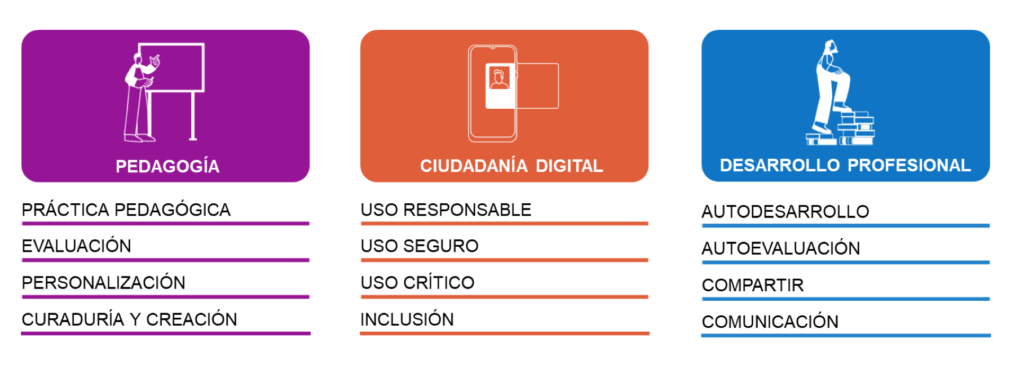
The ProFuturo Foundation has a teacher digital competency framework (the CIEB framework) that it uses to plan its training programs, adapting them to the real expectations and needs of teachers’ professional development and giving them coherence. To identify those real expectations and needs, we use a practical matrix that examines where teachers need to focus in order to make effective use of technology in three core areas:
- Pedagogical: their teaching activities in the school context, as experts in pedagogy and teaching with technology.
- Digital citizenship: as citizens of the new era.
- Professional development: their own learning, in their process of updating and professional development in the digital sphere.
These three areas of transformation require the development of the following 12 core competencies:
To know whether these competencies are being achieved, five levels (levels of appropriation) are used, which show, from lowest to highest, how the teacher is progressing. These levels are:
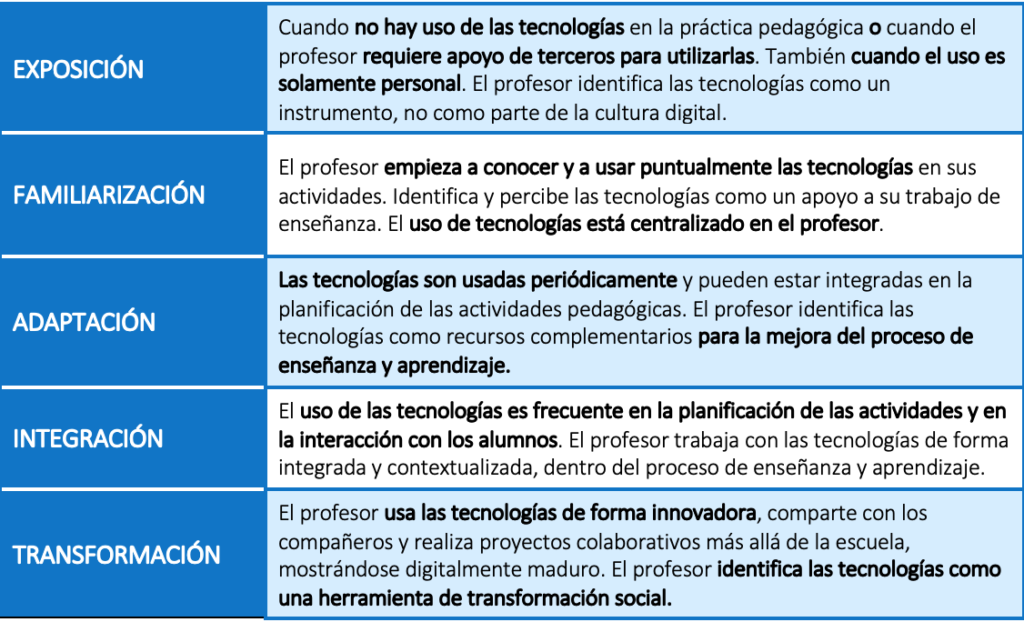
Thus, little by little, starting from a basic level of digital literacy, teachers will become, through practice and hard work, critical leaders who train others and transform their environment… thanks to the potential of Digital Technologies for Information and Communication (TDIC) blended with their pedagogical, professional and civic capabilities.
What is the relationship between teachers’ digital competence and that of their students?
According to UNESCO, in addition to acquiring competencies related to Digital Technologies for Information and Communication and the ability to develop them in their students, teachers must be able to use them to help students become collaborative, creative learners who can solve problems, and innovative and engaged members of society.
Teachers’ digital competencies and those of their students are closely related and complement each other in the digital educational environment. We start from the premise that by increasing teachers’ digital competence, digital competencies can be transferred to students. By promoting the use of technological tools under certain guidelines and aiming at certain objectives


 ProFuturo Observatory Team