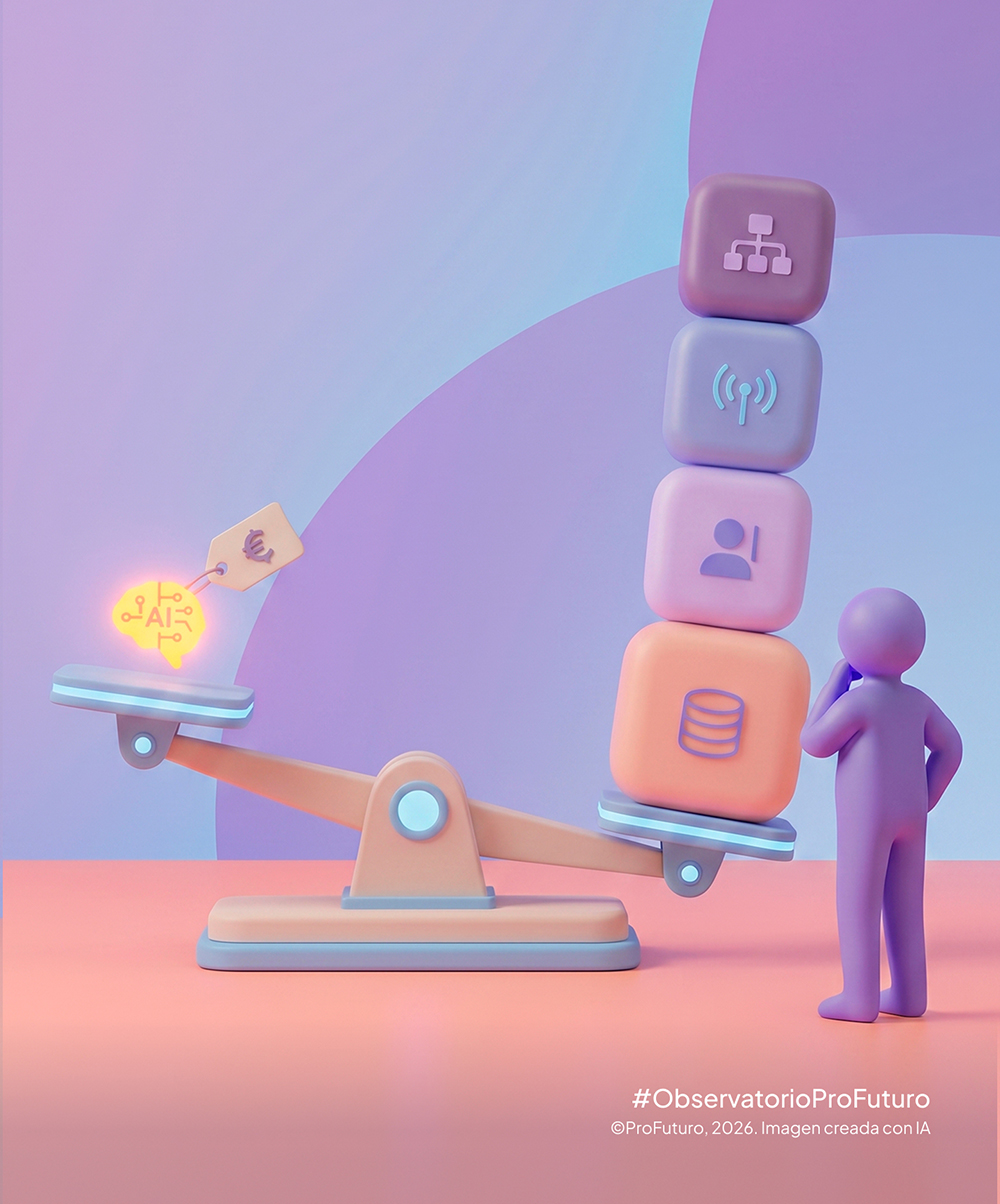

Teachers and AI: a superficial use
Artificial intelligence is already part of the daily work of many teachers. It appears in lesson preparation, in the creation of materials, in the organization of content. It is in this preparatory space where these tools begin to be incorporated more naturally, as part of a process that combines trial, adjustment, and reuse of resources.
The technical note Recommendations for Teacher Training in Artificial Intelligence in Basic Education on teacher training in artificial intelligence, developed by Fundação Telefônica Vivo and the Instituto IA.Edu within the framework of the UNESCO Chair on Unplugged AI in Education, helps us situate this process. Its conclusions are based on a diagnosis that combines focus groups with teachers from different educational stages and an online questionnaire directed at basic education teachers in Brazil. In this article we summarize its main ideas on what uses teachers make of AI and what type of training is most appropriate for them.

And what do the data collected tell us? What are the predominant uses that teachers make of artificial intelligence in their classes? The use of artificial intelligence is concentrated in tasks linked to the design of teaching: generating texts, structuring units, preparing activities or adapting materials. These are functions that are part of the teacher’s regular work and that these tools make it possible to carry out with greater speed or flexibility. Their presence in the dynamics of the class is smaller and appears in a more occasional way.
The difference between these two moments has implications. Incorporating a tool in preparation does not pose the same demands as integrating it into the development of teaching. In the classroom, time, interaction with students, the sequence of activities and the learning objectives come into play. The decision to use artificial intelligence in that context requires more clearly defined criteria regarding its function and its fit within pedagogical practice.
The document captures that distance and links it to an explicit demand for training. Teachers show interest in these technologies and begin to incorporate them into their repertoire, but they point to the need to have guidance and programs that allow them to use them with greater pedagogical consistency, in addition to addressing their ethical and social implications.
A situated form of training centered on teacher autonomy
The incorporation of artificial intelligence in education is often approached from the learning of tools. Courses on platforms, user guides, lists of applications. That approach responds to an initial need, to become familiar with new technologies, but it is insufficient to explain what it means to integrate them into teaching.
Training in artificial intelligence does not consist only in learning to use tools, but in developing criteria to decide their use. That distinction runs throughout the document. Training is presented as a continuous process, linked to teaching practice and adjusted to concrete contexts, rather than as a sequence of courses or occasional training sessions. Knowing how to use a tool is a necessary condition, but not sufficient. More than accumulating technical skills, what makes the difference is integrating technology into the set of decisions that organize teaching.
This approach introduces a shift in the way teacher training is understood. Faced with models centered on technological updating, the document proposes an approach that combines knowledge, practice and reflection. Artificial intelligence is incorporated as part of that process, in dialogue with learning objectives, student characteristics and the conditions of the school environment. Training stops being oriented to the tool and becomes situated in practice.
In that shift, teacher autonomy takes on a central role. Integrating artificial intelligence into teaching implies deciding when to use it, for what purpose and at what moment in the educational process. These are decisions that cannot be resolved through closed instructions or general protocols. They require interpreting situations, weighing alternatives and adjusting the use of technology to each context.
The integration of artificial intelligence in teaching ultimately depends on the capacity to make pedagogical decisions about its use.
The document presents teacher training as a situated process. Infrastructure conditions, teachers’ digital competence and the characteristics of each educational stage all shape how these tools can be incorporated.
There is no single model of training nor a valid sequence for all contexts. What is proposed is a framework that allows teachers to build that judgment.
A more complex training model: teaching, using and understanding AI
The proposal of the document is not limited to expanding the training offer, but introduces a broader framework on what it means to train in artificial intelligence. To do so, it proposes an integration that combines different planes of teaching practice. Artificial intelligence appears, at the same time, as content, as a resource and as an object of reflection.
That integration is articulated around several dimensions that run through training. On the one hand, the need to understand what artificial intelligence is, how it works and what its limits are. On the other, its use in teaching and in the teacher’s own professional work. Added to this is a dimension that the document places in a central position: the capacity to analyze its social, ethical and cultural implications. Three ways of approaching the same technology from different positions within educational practice.
The distinction between teaching about artificial intelligence and teaching with it is especially relevant. First case refers to its incorporation as content: concepts, foundations, the functioning of systems. The second refers to its use as support in the design and development of teaching. The document insists that both dimensions must be developed in an articulated way, avoiding that working with tools replaces the understanding of what they imply.
This approach connects with existing teacher digital competence frameworks. Artificial intelligence is not presented as a separate field, but as an extension of those competencies, incorporating new demands around the use of data, the analysis of algorithms or the evaluation of impacts. Integrating it into training therefore implies expanding and updating skills that are already part of contemporary teaching practice.
The result is a model that seeks to avoid an instrumental reading of technology. Artificial intelligence is not reduced to a set of applications that the teacher learns to handle. It comes to occupy different places in teaching: as content that is learned, as a resource that is used and as a phenomenon that is analyzed. That combination redefines its role in the classroom and in teacher training.
Training in artificial intelligence is not just about learning how to use tools, but about developing the criteria to decide when to use them.
Diagnosis, support and evaluation
The document devotes a large part of its recommendations to how to organize teacher training in artificial intelligence. Not so much to what tools to use or in what format to deliver the courses, but to the conditions that allow that training to have an effect in practice.
The sequence it proposes begins with a diagnosis. Knowing the starting point of teachers, their levels of digital competence, their current uses, the conditions of each school, appears as a requirement to avoid homogeneous proposals that do not fit classroom reality.
From that diagnosis, training is conceived as a set of diverse offers. There is no single format. In-person spaces, synchronous moments and asynchronous resources are combined, with different functions within the training process. In-person meetings allow experimentation, discussion of cases or joint work. Synchronous sessions facilitate support and the resolution of doubts in real time. Asynchronous proposals open space for autonomous study and conceptual deepening. The difference is not in the format, but in how these pieces are articulated according to objectives and the profile of teachers.
In this scheme, support occupies a relevant place. Training is not understood as a one-off process, but as a path that requires follow-up. Mentoring, communities of practice or teacher networks appear as mechanisms to sustain that process over time, allowing the sharing of experiences, adjusting uses and consolidating learning.
Rather than relying on a closed course model, the document describes a system designed to support the gradual incorporation of technology into teaching.
Evaluation follows a similar approach. Continuous monitoring combines different sources of information, including participation in training activities, teacher outputs, evidence of classroom use and changes in digital competencies.
Evaluation stops being located at the end of the process and becomes part of its development, guiding adjustments and decisions as training progresses.
This approach introduces a broader reading of the role of training in the incorporation of artificial intelligence. The impact does not depend so much on the chosen format as on the way the training system is organized. When that system does not start from the teachers’ starting point or does not take into account the diversity of contexts, training tends to remain at more superficial levels. By contrast, when it is built on that basis, the possibility opens up to integrate technology in a more consistent way into educational practice.
What is at stake: equity, judgment and pedagogical decisions
The incorporation of artificial intelligence in education does not take place on neutral ground. Infrastructure, teacher training and the way education systems are organized all shape who can use these technologies, how they are used and with what effects.
The document stresses that existing inequalities also extend into the use of artificial intelligence, affecting both access to these tools and the capacity to integrate them into pedagogical practice.
In this context, artificial intelligence does not automatically expand the possibilities of teaching. It can do so, but it can also reproduce previous differences if its incorporation does not take those conditions into account. The availability of tools does not guarantee their pedagogical use nor their equitable distribution. What makes the difference is the way in which training strategies are designed and the frameworks that guide their use.
One of the responses proposed by the document is the incorporation of approaches that do not depend exclusively on the available technology. So-called unplugged artificial intelligence, that is, activities that allow working on concepts and logics without the need for digital devices, appears as a way to introduce these contents in contexts with infrastructure limitations.
To this dimension is added the ethical question. The use of artificial intelligence in education implies working with data, algorithms and systems that may incorporate biases or generate unforeseen effects. The document proposes that these issues should not be addressed as a separate content, but integrated into teacher training and educational practice. Analyzing how these technologies work, what decisions they incorporate and what implications they have is part of the teaching process, not an external add-on.
Differences between educational stages reinforce this idea. The way in which artificial intelligence is introduced varies according to students’ development and the characteristics of each level, from approaches more linked to logic and experimentation in early stages to greater technical and analytical complexity in later levels. This diversity requires adapting both training and pedagogical proposals to each context.
In this scenario, the effect of artificial intelligence in education is not determined by the technology itself. It depends on the decisions that organize its use: how teachers are trained, what criteria are established to integrate it into teaching and what place it occupies within the education system. It is in that set of decisions where its impact begins to be defined.
Reference
WASSERMAN, Camila; TAMBOR, Jéssica; PRIMO, Tiago Thompsen; CARRATURI, Maria Alice; ISOTANI, Seiji; BITTENCOURT, Ig Ibert. Recommendations for Teacher Training in Artificial Intelligence (AI) in Basic Education. São Paulo: Fundação Telefônica Vivo; Instituto IA.Edu, 2026.