The school that learned to speak about technology and forgot the educational experience
Classrooms filled with screens before we had finished understanding what we wanted to do with them. First came computers; then digital whiteboards, educational platforms, tablets, and applications capable of correcting exercises, organizing tasks, or translating texts in seconds. More recently, artificial intelligence began writing essays, summarizing articles, and generating images with an ease that would have seemed improbable just a few years ago. Educational conversations became saturated with words such as connectivity, digital skills, automation, technological literacy… And yet, something was left behind: the concrete experience of learning.
Because learning has never consisted solely of accessing information. Before responding, one must learn to observe. Producing requires interpretation, and any opinion needs enough pause to identify relationships and nuances. Schools have always worked with these invisible operations as well: attention, perception, the ability to formulate questions and construct meaning. The problem is that technological tools advance much faster than the pedagogical conversations capable of integrating them into coherent learning experiences.
It is within this terrain that a study recently published in the British Educational Research Journal positions itself. Developed by Nella Escala, Montse Guitert, and Teresa Romeu, the research validates a pedagogical model called ABL+DT (Arts-Based Learning with Digital Technologies), designed to integrate arts and digital technologies in primary education. The proposal organizes learning through a sequence of observation, reflection, creation, presentation, and evaluation, in which digital technologies function as tools for researching, documenting, collaborating, and communicating, while the arts act as mediators of experience and interpretation.
The interest of the study goes beyond the model itself. What emerges between the lines is an idea increasingly present in educational research: technology, by itself, changes very little. Its impact depends on how it is incorporated into the pedagogical experience, the relationships it activates, and the kind of thinking it manages to mobilize. The study itself captures a recurring concern among the participating experts: many schools have digital tools, but still struggle to articulate experiences capable of developing creativity, critical thinking, collaboration, or digital competence in meaningful ways.
Long relegated to the decorative margins of the curriculum or to spaces reserved for creative expression, the arts appear in this model as a way of organizing perception and thought. Observing an image, interpreting a scene, discussing meanings, or transforming an idea into a representation requires cognitive capacities that contemporary schools need more than ever: sustaining attention, interpreting ambiguous information, connecting dispersed elements, and constructing meaning amid noise.
Perhaps that is why it is significant that, at the height of the expansion of artificial intelligence, some educational research is turning back toward “the classics.” Not to reject technology, but to ask which human capacities remain indispensable when producing content is no longer the primary challenge.
Art not as content, but as a form of thought
For a long time, the arts occupied an ambiguous territory within schools. They remained at the margins of major discussions about performance, employability, or technological innovation, as if they belonged to a parallel dimension of educational experience: valuable, yes, but secondary. Yet some pedagogical approaches are beginning to recover the idea that art is not merely a discipline to be taught, but a way of seeing and understanding the world.
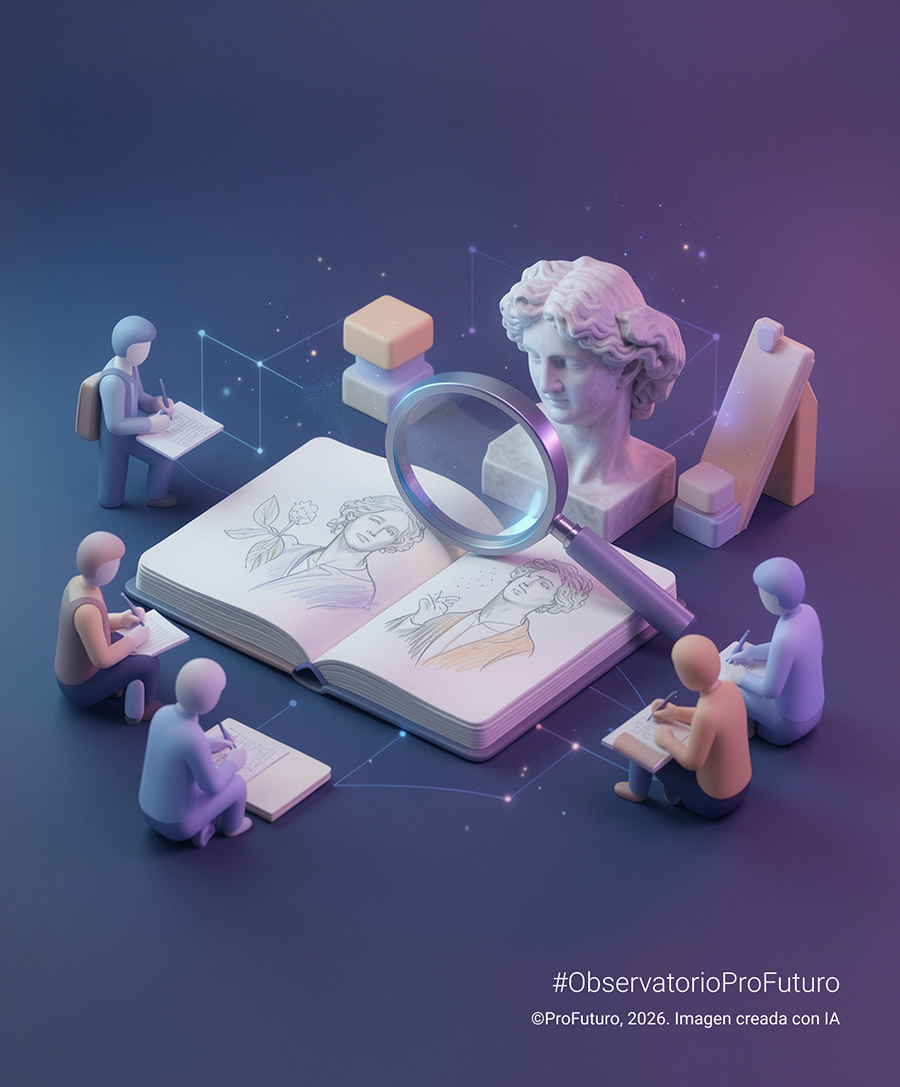
The ABL+DT model is rooted precisely in that tradition. Much of its conceptual architecture refers back to philosopher and educator John Dewey, for whom art was not a separate object detached from everyday life, but an intense form of experience. From this perspective, creating and observing are not ornamental activities: they are ways of organizing attention, exploring relationships, and producing meaning. Learning to look at a painting, a photograph, or a scene involves pausing before something that does not offer a single immediate interpretation. It requires observing details, sustaining questions, accepting ambiguities, and constructing meaning together with others.
The study embraces this idea by placing the arts at the center of the pedagogical process, linked to observation, reflection, and shared interpretation. The experts who participated in validating the model particularly valued participatory methodologies and collective creation experiences, as well as the use of dialogue-based and visual interpretation strategies. In the model, learning is not organized around the repetition of content, but around experiences in which students observe, create, present, and revise their own work.
There is something especially contemporary in this recovery of the arts. In an environment saturated with stimuli, images, and instant responses, observing has become a strangely difficult task. Digital speed encourages the constant displacement of attention: looking without stopping, reading without depth, responding before interpreting. Against that logic, artistic practices introduce another temporality. They demand slowness, exploration, and a certain resistance to immediacy.
That is why it is interesting that the study links the arts with capacities such as interpretation, imagination, collaboration, and the construction of meaning, rather than simply with creativity understood in abstract terms. What is at stake here is not only the possibility of “self-expression,” but the capacity to perceive nuances, connect scattered ideas, and develop an independent perspective on reality. The arts function here as cognitive technologies: human tools for thinking, interpreting, and understanding complex experiences.
This dimension becomes even more relevant in a context marked by the expansion of generative artificial intelligence. Machines can produce images, draft texts, and answer questions with increasing efficiency. But interpreting an ambiguous situation, constructing meaning from contradictory elements, or sustaining an open conversation about a work of art remain profoundly human processes. Educational value no longer lies solely in producing content, but in developing the capacities needed to read it critically, transform it, and give it meaning.
In the model validated by the study, digital technologies do not replace that experience. They expand it. They make it possible to document processes, create multimodal narratives, share productions, and connect classrooms with other contexts and communities. But the core of learning remains elsewhere: in the experience of observing, interpreting, creating, and thinking together with others.
Long relegated to the decorative margins of the curriculum or to spaces reserved for creative expression, the arts appear in this model as a way of organizing perception and thought.
Technology changes little if pedagogy does not change
Schools learned relatively quickly to incorporate digital tools. But transforming the learning dynamics surrounding them has happened much more slowly. In many classrooms, technology ended up adapting to already familiar pedagogical structures: individual exercises transferred onto screens, platforms used as repositories for assignments, or digital activities that barely alter the traditional logic of content transmission. Technological novelty then coexists with surprisingly stable forms of teaching.
The interest of the ABL+DT model lies precisely in attempting to intervene at that deeper level: not in the isolated tool, but in the architecture of the pedagogical experience. The study describes a process organized around five moments — observing, reflecting, creating, presenting, and evaluating — that function as a continuous sequence of inquiry and collective meaning-making. Digital technologies are integrated within that journey, not as an end in themselves, but as means for exploring, documenting, collaborating, and communicating.
Observation occupies a central place. Learning begins with an image, a work of art, a question, or a situation connected to the students’ social environment. From there unfolds a process of shared interpretation that combines dialogue, reflection, and creation. The objective is not merely to acquire curricular content, but to activate forms of thinking capable of connecting knowledge, experiences, and diverse contexts. Digital technologies make it possible to expand that experience: recording processes, constructing visual narratives, editing materials, sharing productions, or connecting the classroom with external audiences.
The study insists that learning becomes more meaningful when students stop occupying a passive place within the process. The model incorporates participatory and collaborative methodologies that position students as creators rather than mere recipients of information. In the validation carried out with experts from Spain and Ecuador, one of the highest-rated dimensions was precisely the creation phase. Participants highlighted the relevance of collaborative artistic experiences and the potential of digital technologies to enrich processes of inquiry, communication, and collective production.
Underlying this shift is an important idea. Digital competence is no longer reduced to the technical mastery of specific tools, but is instead understood as the ability to use technologies within complex processes of thought, creation, and social participation. The study draws on international frameworks such as DigComp and DigCompEdu, which propose moving beyond instrumental views of digital literacy toward more critical, ethical, and pedagogically situated uses of technology.
Another significant change also emerges: production is no longer directed solely toward the teacher. Presenting, sharing, and publicly discussing work becomes part of learning itself. The classroom opens itself to other interlocutors — families, communities, cultural institutions — and creation acquires a communicative and social dimension. Digital technologies facilitate that openness, but do not guarantee it by themselves. What remains decisive is the way the experience has been designed.
Learning to observe in the age of artificial intelligence
Every era educates attention differently. There was a time when learning meant memorizing stories transmitted orally around a fire. Later came manuscripts, margins filled with annotations, and silent libraries where entire generations learned to read slowly. Today, everyday experience unfolds among screens constantly competing for fragments of attention. Images succeed one another rapidly, texts are condensed into a few lines, and answers appear before we have even finished formulating the questions.
The expansion of artificial intelligence intensifies this sense of speed even further. It has never been easier to produce texts, summarize information, or generate images in a matter of seconds. But precisely because of that, some capacities are beginning to acquire a different kind of value. Interpreting, connecting ideas, distinguishing nuances, sustaining a complex conversation, or constructing meaning amid informational overabundance are tasks that require more than technological access.
Perhaps that is why it is significant that part of contemporary educational research is turning once again toward experiences linked to observation, creation, and shared reflection. The ABL+DT model belongs to that movement. It does not propose an opposition between the arts and technology, nor a pedagogical nostalgia in the face of the digital world. What it proposes is another question: what kind of human experience do we want to preserve and develop when technological tools automate more and more cognitive processes?
In the study, the arts appear linked to forms of slow and meaningful attention. Observing a work, constructing a collective interpretation, or transforming an idea into a visual creation requires pausing before complexity. Digital technologies, integrated into that process, expand the possibilities for inquiry, documentation, and communication. But the core of learning remains tied to something more elemental and more difficult to automate: the experience of observing, thinking, and creating together with others.
Perhaps that is where one of the most important questions for contemporary schools resides. For decades, much of educational effort was oriented toward guaranteeing access to information and technologies. That challenge remains fundamental. But digital abundance has shifted the problem elsewhere. It is no longer enough simply to access. It is also necessary to interpret, select, connect, and give meaning.
In that context, learning to observe ceases to be a gentle metaphor about the arts. It becomes a profoundly contemporary capacity. Because before producing responses — human or artificial — it is still necessary to understand the world in front of us.